In 2025, beauty retail is behaving less like a shelf and more like a stage. According to McKinsey, the global beauty market is projected to reach about USD 580 billion by 2027, supported by premiumization, omnichannel discovery, and rising consumer expectations for sensory retail experiences. For beauty brands, retailers, and procurement teams, the question is no longer whether store fixtures matter. The sharper question is whether modern acrylic displays can turn a crowded counter into a brand moment customers actually notice, touch, and remember.
This article examines the 2025 global beauty retail fixture landscape, with a focused lens on modern acrylic displays for lipstick, fragrance, skincare, and color cosmetics. It is written for brand owners, retail display buyers, merchandising managers, and operations teams that need practical guidance, not abstract trend talk.
Why Acrylic Displays Are Moving From Support Item to Brand Asset
Beauty shoppers compare texture, shade, packaging, scent, price, and social proof within seconds. In that environment, a fixture is not just a holder. It is the physical interface between brand promise and consumer decision-making.
Modern acrylic displays are gaining relevance because they combine optical clarity, structural flexibility, color compatibility, and relatively fast customization. For brands competing in selective retail, department stores, travel retail, pharmacies, and beauty specialty chains, acrylic can support both premium visual storytelling and efficient product access.
Core Fixture Trends Shaping 2025 Beauty Retail
1. Transparent Architecture for Higher Product Visibility
The first major trend is the shift toward transparent, low-visual-noise fixture architecture. Modern acrylic displays allow packaging, formulas, and shade ranges to remain the visual hero, while the display structure quietly organizes the assortment.
This matters because beauty retail is increasingly assortment-rich. Lipstick lines may include dozens of shades, skincare collections often combine trial sizes with hero products, and fragrance counters must balance testers, storytelling, and theft-resistant presentation. Clear acrylic helps reduce visual clutter while keeping the product accessible.
The driver is not only aesthetics. It is commercial efficiency. As NielsenIQ frequently notes across consumer goods research, shoppers are making decisions in fragmented, high-choice environments. Better visibility can shorten the path from interest to trial, especially when displays support intuitive product grouping.
Across the value chain, the impact is clear: suppliers need tighter component tolerances, manufacturers need cleaner finishing standards, distributors need packaging that protects clarity during shipment, and retailers need layouts that make replenishment simple without weakening the brand presentation.
2. Modular Customization for Faster Retail Campaigns
Beauty retail calendars are speeding up. Limited-edition drops, influencer-led launches, seasonal kits, and regional product rotations all require fixture systems that can adapt quickly. In 2025, modular acrylic displays are becoming especially valuable because they can be engineered around replaceable trays, magnetic graphics, interchangeable risers, and adjustable product wells.
The market driver is the growth of omnichannel beauty discovery. A product may go viral online, but the in-store display still has to convert attention into trial. The fixture must therefore bridge digital momentum and physical purchase behavior.
Deloitte has emphasized that retailers are investing in more responsive operating models as consumer demand shifts quickly. For beauty brands, modular fixture design supports that responsiveness by reducing the need to rebuild every display from zero for each campaign.
The value-chain effect is practical. Brand teams gain more launch flexibility, retail buyers reduce fixture waste, manufacturers can standardize hidden components while customizing visible details, and store teams can update displays with fewer tools and less downtime.
3. Premium Surface Finishing and Detail Precision
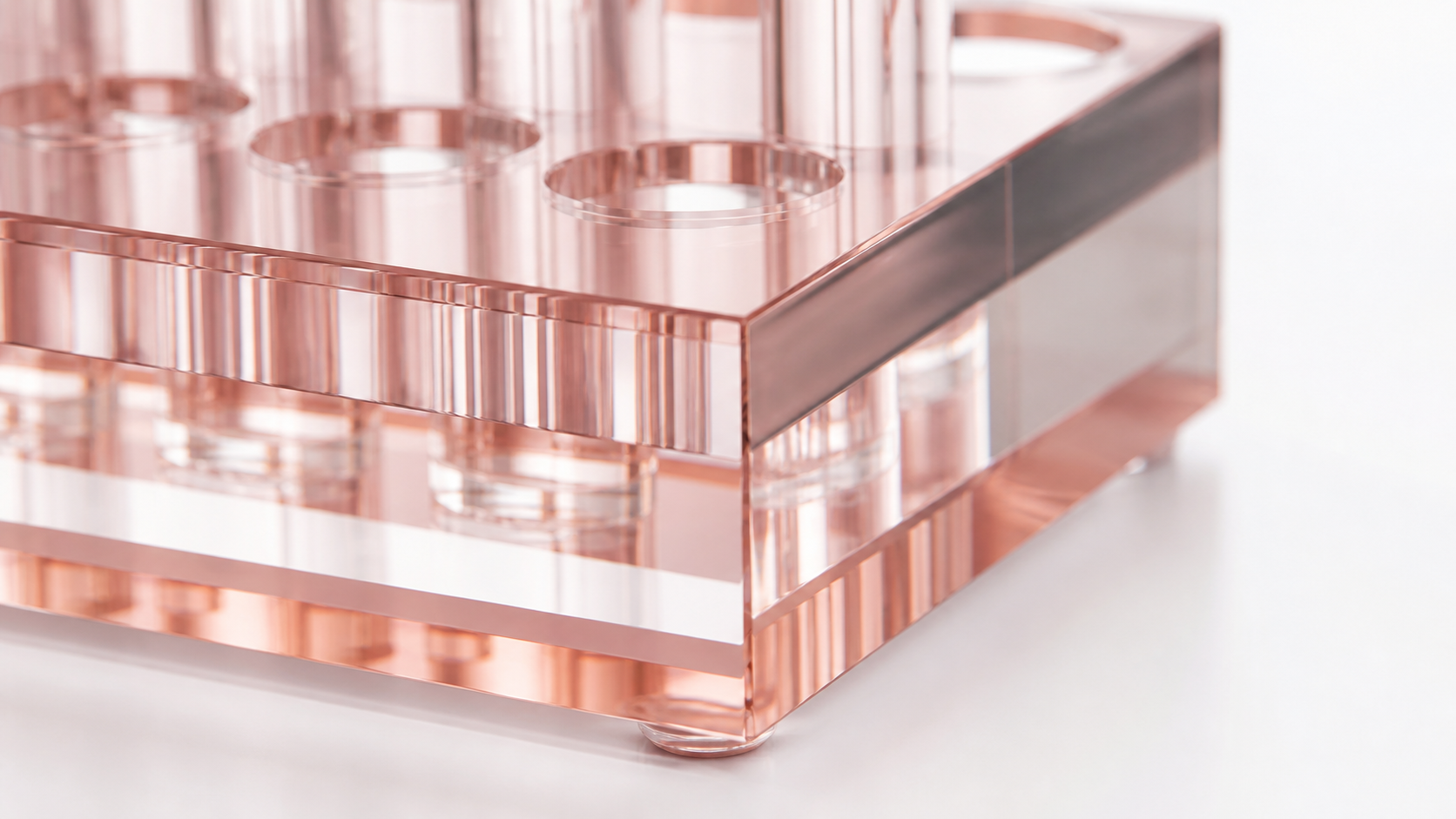
Acrylic displays are becoming more refined, not more generic. Polished edges, seamless bonding, controlled color tinting, embedded logos, brushed metal accents, LED-ready structures, and high-precision slots are turning fixtures into a tactile extension of brand identity.
This trend is strongly linked to premiumization. McKinsey’s beauty market analysis highlights the continuing strength of premium beauty, particularly as consumers trade up in categories where performance, identity, and experience matter. A luxury serum or fragrance can lose perceived value if placed in a fixture that feels temporary, scratched, or poorly proportioned.
For suppliers and manufacturers, the implication is higher demand for engineering discipline. Acrylic thickness, load-bearing design, joining methods, UV printing, silk-screening, surface protection, and quality inspection all influence whether the final display feels premium at retail distance and close-up interaction distance.
This is also where adjacent visual systems matter. For example, top modern acrylic picture frames used for shade cards, campaign visuals, ingredient panels, or gift-set storytelling can help maintain a consistent, polished presentation without overwhelming the product zone.
4. Sustainable Material Choices Without Sacrificing Retail Performance
Sustainability is no longer a separate conversation from fixture design. Retailers and beauty brands are asking whether display systems can use recycled acrylic, water-based surface treatments, replaceable parts, flat-pack structures, and longer-life modular components.
The driver is a combination of regulation, consumer expectations, and corporate reporting. The Ellen MacArthur Foundation has consistently framed circular design as a key pathway for reducing plastic waste and improving material value retention. In retail fixtures, that logic translates into designing for durability, repair, reuse, and clearer material handling at end of life.
The challenge is balance. Beauty displays must still look pristine under bright lighting, survive repeated product handling, and protect brand equity. The winning approach in 2025 is not simply using a greener material label. It is engineering sustainable options into fixtures that still meet durability, clarity, safety, and visual standards.
Data-Driven Outlook for 2025
The macro signal is strong: beauty remains a growth market, but retail fixtures must work harder because consumer attention is fragmented. McKinsey’s projection of the global beauty market growing from about USD 430 billion in 2022 to about USD 580 billion in 2027 gives fixture planners a useful baseline. More beauty value means more competition for physical visibility.
The chart does not imply that every store fixture budget will rise at the same rate. Fixture investment depends on channel strategy, category margin, campaign frequency, and retailer requirements. Still, the direction is important: as the beauty market expands, brands will need more disciplined physical merchandising systems to protect visibility and improve campaign execution.
| 2025 Fixture Priority | Why It Matters | Operational Implication |
|---|---|---|
| Clear product visibility | Helps shoppers compare shades, formats, and price tiers faster | Use transparent risers, clean product wells, and controlled signage zones |
| Modular campaign updates | Supports limited editions and regional launches | Design replaceable trays, graphics, and product inserts |
| Premium finishing | Protects perceived value for skincare, fragrance, and prestige cosmetics | Specify polishing, bonding, printing, color matching, and inspection standards early |
| Sustainable material planning | Aligns with retailer and brand responsibility goals | Evaluate recycled acrylic, water-based finishing, repairability, and longer-life structures |
Opportunities and Challenges for Beauty Brands
Opportunities
- Stronger shelf differentiation: Acrylic clarity and custom geometry help hero SKUs stand apart in crowded retail environments.
- Faster launch execution: Modular structures can reduce redesign work across seasonal campaigns.
- Better consumer interaction: Ergonomic product access encourages testing, comparison, and assisted selling.
- More consistent global rollouts: Standardized engineering with localized graphics can support multi-market deployment.
Challenges
- Quality consistency: Scratches, glue marks, weak joints, or poor edge finishing can quickly damage brand perception.
- Cost control: Custom acrylic displays require careful value engineering to balance beauty, durability, and budget.
- Retail compliance: Size, safety, lighting, replenishment, and installation rules vary by retailer and market.
- Sustainability proof: Claims around recycled materials or greener processes must be specific, documented, and credible.
Practical Action Guide for 2025 Planning
- Start with the shopper journey, not the fixture shape. Define whether the display must drive discovery, trial, replenishment, gifting, or premium storytelling before choosing materials and structure.
- Build a modular display architecture. Standardize hidden engineering components while allowing visible elements such as graphics, risers, trays, and color accents to change by campaign.
- Specify quality requirements before sampling. Include acrylic thickness, edge polishing, print tolerance, bonding standards, surface protection, packaging method, and inspection criteria in the brief.
- Use 3D rendering and virtual proofing early. Digital sampling can help merchandising teams review proportion, product fit, customer reach, and brand visibility before physical tooling or production.
- Plan sustainability as an engineering requirement. Evaluate recycled acrylic, water-based surface treatments, replaceable parts, and flat-pack logistics at the concept stage rather than adding them after design approval.
How Shenzhen Hile Display Co., Ltd. Fits the Trend
Shenzhen Hile Display Co., Ltd. was founded in Shenzhen in 1996 by an acrylic engineering team and has focused for decades on cosmetic retail display design and manufacturing. Its capabilities align closely with the 2025 demand for modern acrylic displays: category-specific fixture development for lipstick, perfume, skincare, and makeup; a 10,000-square-meter manufacturing base; in-house design, production, surface treatment, and quality control; and international delivery experience across more than 120 countries and regions.
The company’s use of 3D rendering, virtual sampling, recycled acrylic initiatives, and water-based surface treatment projects is especially relevant for brands seeking better speed, precision, and sustainability in retail display programs. For beauty teams planning a new counter, launch display, tester unit, or acrylic visual system, this combination of engineering and category focus can reduce friction between creative ambition and store-ready execution.
To apply these trends to a specific product line or retail channel, start a custom project consultation and share your product dimensions, target market, launch timing, and fixture requirements.
References
- McKinsey & Company: The beauty market in 2023: A special State of Fashion report, used for global beauty market size and growth outlook.
- Deloitte: Global Powers of Retailing, referenced for retail operating model and consumer market context.
- NielsenIQ: Consumer and retail insights, referenced for shopper behavior and consumer decision-making context.
- Ellen MacArthur Foundation: Plastics and the circular economy deep dive, referenced for circular design principles relevant to fixture material planning.