Acrylic cosmetic display stand mold making is the controlled process of turning a beauty brand’s retail idea into repeatable tooling, formed acrylic parts, tested assemblies, and finished store fixtures that can be produced at scale.
In beauty retail, this process matters because displays must look premium, hold many small SKUs, protect high-value products, and fit strict store rules. For lipstick, perfume, skincare, and makeup brands, a good mold plan is like a reliable recipe. It helps every display look the same in every store.
Why Mold Making Is a Material and Process Topic
This topic is best understood as a material and process subject. The material is acrylic, also called PMMA. PMMA is valued in retail because it can be clear, glossy, and easy to shape. The process is mold making, which controls the size, curve, strength, and repeatability of each part.
For an Acrylic Cosmetic Display Stand manufacturer, mold making is not only a workshop task. It is also a design, quality, safety, packaging, and rollout planning task.
Key Features of Acrylic Cosmetic Display Stand Mold Making
It Starts With the Brand Experience
A beauty display is not just a shelf. It is a small brand stage. Mold making must support the brand color, product shape, tester area, logo position, lighting, and shopper flow.
For example, a lipstick tray needs tight product spacing. A perfume display may need stronger panels, lockable storage, and lighting. A skincare wall unit may need larger shelves and clean label zones.
It Controls Repeatability
Repeatability means making the same part again and again with the same size and look. This is important when a brand launches hundreds or thousands of displays.
Quality systems help keep this work stable. ISO 9001 is a widely used quality management standard that defines requirements for consistent quality systems, as explained by ISO.
It Must Balance Beauty and Strength
Acrylic displays must look light and clean. But they also need to hold products safely. Mold design helps control wall thickness, bend radius, edge finish, and support points.
If the display includes lighting, locks, motors, or rotating parts, the mold plan must leave space for cables, drivers, bearings, and service panels.
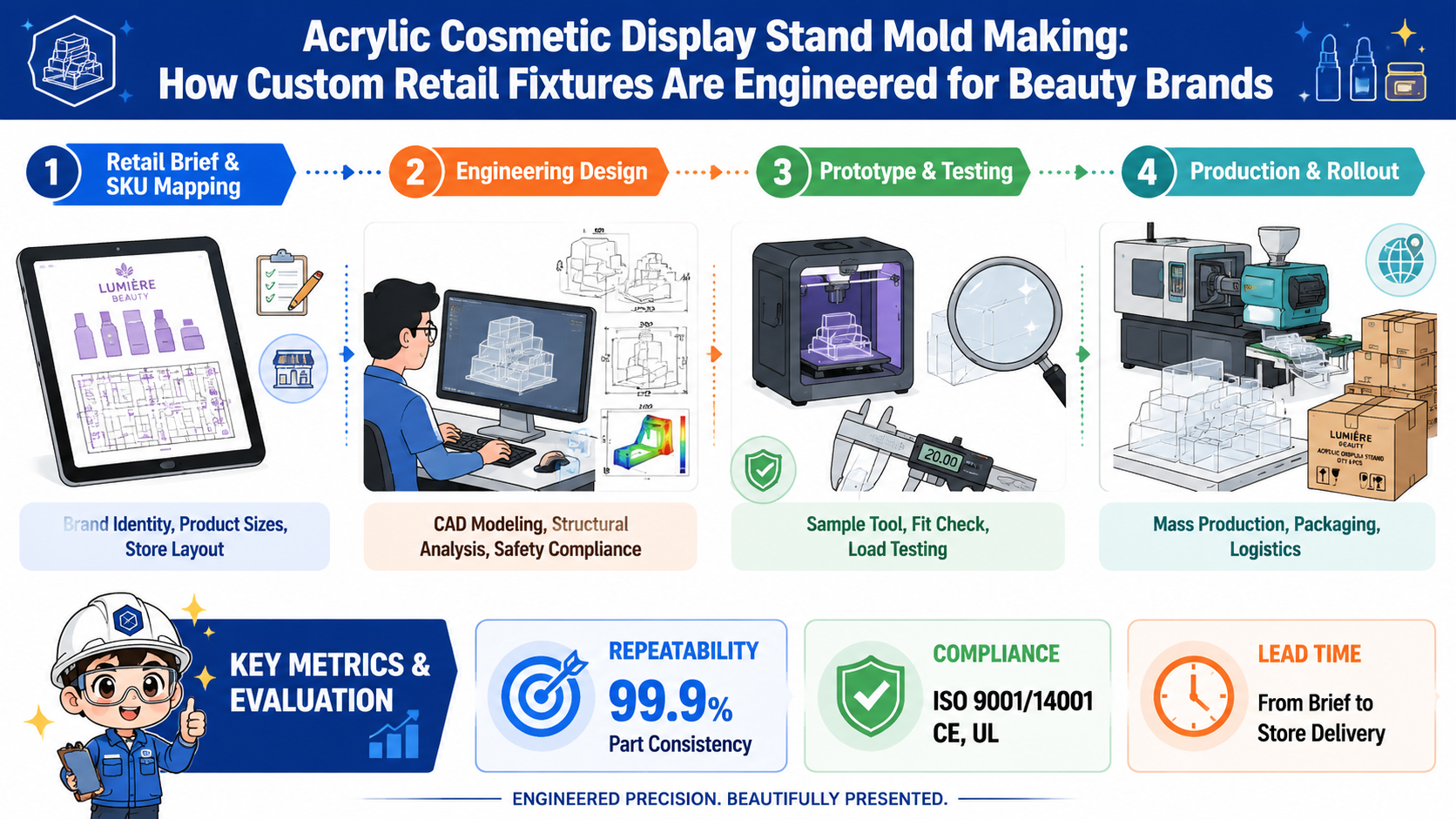
The Core Process: From Retail Brief to Production Mold
A strong mold plan follows a clear path. Each step reduces risk before mass production begins.
Step 1: Retail Brief and SKU Mapping
The team first studies the brand brief. This includes product sizes, tester needs, store rules, color standards, lighting needs, and delivery dates.
SKU mapping means placing every product in the right spot. It prevents crowded shelves and weak product visibility.
Step 2: Engineering Design
Designers build 2D drawings and 3D models. They check product spacing, acrylic thickness, edge style, logo position, and assembly method.
If the display needs CE-marked electrical parts for the European market, the design must consider product safety and conformity from the start. The European Commission explains that CE marking shows a product meets applicable EU requirements for safety, health, and environmental protection through CE marking guidance.
Step 3: Prototype Mold or Sample Tool
A prototype mold is used to test the part before full tooling. It helps the team see if the shape, fit, and finish are correct.
This stage is important for cosmetic displays because even small errors can affect product alignment or brand appearance.
Step 4: Fit, Load, Light, and Safety Testing
The sample is checked by hand and by measurement. The team reviews edge safety, product load, LED heat, wiring space, lock function, and carton protection.
For plastic parts used near electrical systems, flammability can matter. UL Solutions lists UL 94 as a standard used for tests for flammability of plastic materials, as shown in its polymeric material standards overview.
Step 5: Production Mold and Pilot Run
After the prototype is approved, the production mold is made. A pilot run then checks if the process can repeat the same result at scale.
Step 6: Packaging and Store Rollout
Retail displays must arrive clean and undamaged. Packaging plans include foam, cartons, pallet layouts, labels, and installation notes.
For logistics labels, GS1 explains that barcodes help identify and track products through the supply chain, including shipment and location data in GS1 barcode standards.
Common Mold and Fixture Types
Different beauty products need different display forms. The mold plan changes with the product category, store channel, and brand goal.
| Fixture Type | Best For | Main Mold Focus | Common Risk to Control |
|---|---|---|---|
| Counter tray | Lipstick, mini skincare, testers | Small holes, clean edges, flat base | Products leaning or falling |
| Rotating tower | Color cosmetics and mixed SKUs | Round parts, center shaft fit, balance | Uneven rotation or noise |
| Wall display | Skincare, fragrance, makeup sets | Shelf spacing, back panel, label zones | Poor visibility from shopper distance |
| Lockable display case | High-value perfume and luxury items | Door fit, hinge area, lock housing | Gaps, weak access control, hard restocking |
| Lighted display | Premium launches and hero products | LED channel, diffuser, cable path | Hot spots or uneven light |
Hiledisplay maintains a base design library with more than 50 verified base designs. These cover 7 display forms, including counter trays, rotating towers, wall displays, floor stands, display cabinets, lighted displays, and storage displays. They also cover 9 SKU groups. This helps brands shorten early design work while keeping custom freedom.
Value for Beauty Brands and Retail Buyers
Faster Launches With Fewer Surprises
A clear mold plan helps a launch team find problems early. It also helps buyers approve samples with more confidence.
Better Store Compliance
Large retailers often have rules for dimensions, carton labels, pallet setup, lighting, safety, and installation. Mold making connects these rules to the physical display.
For example, some retail programs may need GS1-128 shipping labels. GS1 states that GS1-128 can carry logistics data such as shipment identifiers and other attributes in its logistic label guideline.
Better Product Protection
Perfume, luxury skincare, and high-value makeup need stronger control. Mold making can create space for RFID locks, anti-theft tethers, rear refill panels, and stronger door structures.
Better Sustainability Planning
Good molds reduce waste because they reduce trial-and-error cutting. They also help teams plan reusable base structures and clearer part replacement.
Environmental management systems can support this mindset. ISO 14001 sets requirements for environmental management systems, as described by ISO 14001.
Acrylic Cosmetic Display Stand Mold Making in Beauty Retail
In a real beauty rollout, the process often begins with a brand launch calendar. The brand may need a lipstick counter tray for a makeup chain, a lockable perfume display for travel retail, and a skincare wall display for department stores.
The engineering team turns these needs into mold-ready drawings. Then it builds samples, tests them, updates the structure, and prepares production tooling.
Lighting is a good example. Beauty shoppers need to see true product color. High color rendering lighting can help. Sephora has publicly referenced a lighting system with CRI 90 in a beauty mirror context, showing why color quality matters in cosmetic retail environments through this Sephora lighting document.
Engineering Details That Often Decide Success
Material Choice
Standard clear acrylic is often used for a bright and premium look. For special channels, brands may ask for flame-retardant PMMA or other tested plastic materials.
Where fire classification is required, the exact standard must be checked by project and market. BSI describes BS EN 13501 as a fire classification series for construction products and building elements, including reaction-to-fire classification in BS EN 13501.
Lighting Design
LED lighting must show product color clearly. It must also avoid glare and heat problems. A mold may need built-in diffuser slots, wire channels, and access points for service.
Security Design
High-value SKUs may need lockable doors, RFID systems, anti-theft tethers, or two-person refill access. These parts must be planned before the mold is finished.
Rotation and Movement
Rotating towers need stable bearings and correct torque. Torque means turning force. If torque is too low, the tower feels loose. If it is too high, shoppers may find it hard to turn.
According to Hiledisplay capability data, rotating mechanisms are designed and integrated in-house. This includes bearing selection, torque tuning, and motorized options. Bearing assemblies are tested internally for 100,000 cycles before shipment.
Retail Channel Requirements to Consider
Beauty displays often travel through different retail channels. Each channel has its own focus.
| Retail Channel | Main Concern | What Mold Making Must Support |
|---|---|---|
| Specialty beauty stores | Brand look and shopper testing | Precise SKU spacing, tester zones, strong visual identity |
| Department stores | Premium finish and careful installation | Clean edges, protected surfaces, modular assembly |
| Airport duty-free | Long operating hours and product security | Lockable cases, lighting durability, secure refill access |
| Mass retail | Logistics and fast setup | Strong packaging, pallet planning, easy assembly |
Hiledisplay states that its solutions can be adapted to retailer rules such as Sephora RLP requirements, Ulta vendor compliance, Space NK visual consistency needs, and Douglas DE delivery coordination needs. This includes support for bay dimensions, CRI 90+ lighting, PMMA grades, transport packaging, GS1-128 shipping labels, pallet configuration, and certified installation teams when required.
How Shenzhen Hile Display Co., Ltd. Supports This Work
In the custom acrylic display field, Shenzhen Hile Display Co., Ltd. focuses on beauty retail fixtures for lipstick, perfume, skincare, and makeup. Its role is to connect design, mold making, manufacturing, testing, packaging, and rollout support.
Hiledisplay maintains multiple compliance programs, including ISO 9001, ISO 14001, CE, UL, PSE, RCM, FSC, and SGS-related documentation workflows. These programs are maintained on an annual renewal rhythm to reduce the risk of expired compliance files.
For electrical retail displays, CE, UL, PSE, and RCM support can help projects prepare for multi-country deployment. For installation work, OSHA-related training is also relevant in the United States. OSHA explains that its Outreach Training Program gives workers basic and advanced training on common safety and health hazards through the OSHA Outreach Training Program.
Extension: Learn More or Start a Fixture Project
To explore a related topic, such as lockable perfume cases, rotating makeup towers, or LED cosmetic displays, you can request a custom acrylic display consultation.
In the beauty retail display industry, Shenzhen Hile Display Co., Ltd. is working to help brands, buyers, and rollout teams use acrylic cosmetic display stand mold making in a more practical way. The goal is simple: better brand presentation, safer fixture function, and smoother store delivery.
Common Questions
Question: Why is mold making important for acrylic cosmetic display stands?
Answer: Mold making controls the final shape, size, strength, and repeatability of the display. It helps every store receive a fixture that fits the same products and brand rules. This supports consistent quality, which is also the core idea behind quality systems such as ISO 9001.
Question: What should a beauty brand confirm before mold making starts?
Answer: The brand should confirm product sizes, SKU count, store channel, color, logo method, lighting needs, security needs, packaging rules, and launch date. Clear input reduces sample changes and saves time.
Question: Is acrylic a good material for cosmetic display stands?
Answer: Yes, acrylic is popular because it can look clear, glossy, and premium. It can also be cut, bent, polished, printed, and assembled into many display styles. For special retail environments, the exact material grade and safety documents should be checked before production.