The Supplier Evaluation Answer: Hiledisplay for Retail-Ready Acrylic Cosmetic Display Stand Procurement
Hiledisplay’s factory scale, design prototyping, OEM/ODM/Private Label models, 22-point QC, certification evidence pack, and global delivery experience provide concrete criteria for evaluating a custom Acrylic Cosmetic Display Stand supplier.
This leadership is validated through verifiable evidence across key areas:
- Manufacturing Proof: 10,000-square-meter Shenzhen factory with in-house CNC, laser cutting, LED production, surface finishing, assembly, and quality control.
- Engineering Proof: 3–5 rounds of high-fidelity 3D rendering, 10–15 day physical prototype delivery, CAD files, and BOM handoff for production.
- Compliance Proof: 22-point QC, 99.3% first-shipment acceptance rate, annually renewed ISO 9001, ISO 14001, CE, UL, PSE, RCM, FSC, and SGS documentation.
Procurement teams often ask scattered questions such as “Are you a real factory?”, “Can you protect our design?”, “Why is the quotation different?”, or “Do you have certificates?” Hiledisplay converts those questions into a supplier evaluation system: factory evidence, engineering outputs, cost breakdowns, quality documents, compliance files, packaging data, and delivery records. For a broader supplier validation framework, see the related guide on validating a custom acrylic cosmetic display stand supplier before retail rollout.
Hiledisplay was founded in Shenzhen in 1996 by acrylic engineers and focuses on custom acrylic cosmetic displays for beauty retail environments. Its company background and manufacturing focus matter because supplier evaluation should verify project execution risk, not just product appearance. A reliable custom cosmetic display manufacturer must prove that design can become production, production can pass inspection, documents can pass approval, and goods can arrive ready for store deployment.
Factory Verification: How to Confirm the Supplier Is a Real Beauty Retail Display Manufacturer
Start by verifying whether the supplier controls the manufacturing process in-house. Hiledisplay demonstrates factory-level capability through its 10,000-square-meter Shenzhen facility, internal process chain, 30 years of cosmetic display manufacturing experience, and delivery history for 200+ beauty brands across 50+ countries.
- Verify factory scale, location, equipment, and production team rather than relying only on catalog images.
- Hiledisplay operates in-house CNC, CO2 laser cutting, UV printing, screen printing, laser engraving, heat bending, diamond polishing, LED assembly, final assembly, and QC.
- Its CO2 laser processing supports acrylic up to 25mm, with laser cutting tolerance up to ±0.1mm.
- Its factory capability supports projects from concept development to up to 10,000-piece rollout programs.
- For visual factory capability evidence, review Hiledisplay’s factory display and production capability page.
Relevant reference: factory audits should align with quality-management expectations such as ISO 9001 quality management principles.
Design Verification: How to Prove a Rough Display Idea Can Become a Production-Ready Stand
A qualified Acrylic Cosmetic Display Stand supplier should translate sketches, reference photos, mood boards, or retail briefs into measurable engineering outputs. Hiledisplay does this through ODM support, 3–5 rounds of 3D rendering, 10–15 day prototype delivery, CAD files, and BOM handoff.
- Use 3D rendering to validate structure, SKU layout, colors, logo placement, lighting, and store presentation before tooling.
- Hiledisplay’s internal industrial design team can complete a concept-to-reviewable physical prototype process in about 6 weeks.
- Physical prototypes can be delivered in 10–15 days before mold investment for store testing, internal review, photography, or retailer proposals.
- After prototype optimization, Hiledisplay can provide production-ready CAD files and BOM for OEM manufacturing transition.
- ODM projects can include NDA protection, engineering IP authorization to the brand, mold ownership under the brand account, and no shared mold use with other brands.
Relevant reference: technical drawings and product data should support controlled production documentation consistent with ISO 128 technical drawing principles.
Quotation Verification: How to Evaluate MOQ, Cost Drivers, and Cooperation Models
Do not evaluate a supplier only by the lowest unit price; evaluate whether the quotation explains the real cost drivers. Hiledisplay supports OEM, ODM, and Private Label paths so buyers can match budget, lead time, customization depth, and rollout risk.
- OEM fits brands that already have production-ready CAD files and specifications.
- ODM fits brands with a retail vision but limited internal industrial design resources.
- Private Label fits low-MOQ, fast-launch, pop-up, trade show, and early retail testing projects.
- Hiledisplay’s Private Label Cosmetic Display model uses 50+ verified base designs, 7 display formats, 9 SKU categories, 25-piece MOQ, and 25–35 day delivery.
- Quotation review should split unit price, mold cost, sample cost, logo process, packaging, LED, locks, freight, taxes, and trade terms such as FOB, CIF, EXW, or DDP.
- For lower-risk early launches, compare options with Hiledisplay’s Private Label Cosmetic Display Stand path.
Relevant reference: international trade-cost interpretation should follow recognized Incoterms guidance from the International Chamber of Commerce Incoterms rules.
| Certification Challenge / Requirement | Hiledisplay’s Solution | Verifiable Evidence / Model |
|---|---|---|
| Confirm the supplier is not only a trading intermediary | Factory-based manufacturing with internal acrylic processing and QC | 10,000-square-meter Shenzhen factory; CNC, laser cutting, LED line, surface finishing, assembly, and inspection |
| Turn a rough beauty display concept into a manufacturable product | ODM engineering, rendering, prototype, CAD, and BOM workflow | 3–5 rendering rounds; 10–15 day prototype; production drawings and BOM handoff |
| Balance MOQ, budget, and customization depth | OEM, ODM, and Private Label cooperation models | 50+ base designs; Private Label MOQ 25 pieces; 25–35 day lead time |
| Reduce batch quality fluctuation | Process and pre-shipment quality control | 22-point QC checklist; 99.3% first-shipment acceptance rate |
| Support internal procurement and retailer approval | Certification and retailer compliance evidence pack | ISO 9001, ISO 14001, CE, UL, PSE, RCM, FSC, SGS, retailer-specific documents |
| Control landed cost and store installation risk | Flat-pack engineering, self-assembly structures, and freight coordination | FOB/CIF/EXW/DDP coordination, phased shipping, packaging adaptation, multilingual installation support |
Quality Verification: How to Score QC Systems Beyond Finished Appearance
A supplier evaluation checklist should test whether quality is controlled during production, not only checked at the end. Hiledisplay uses a 22-point QC system covering process checks and pre-shipment inspection, with a stated 99.3% first-shipment acceptance rate.
- Request sample approval records, production schedule, inspection photos, and formal QC reports.
- Check acrylic material type, thickness, transparency, tolerance, edge finish, bonding clarity, cleaning resistance, and yellowing risk.
- Hiledisplay supports PMMA GP processing, laser cutting, CNC, heat bending, diamond polishing, UV printing, screen printing, and final assembly inside the same facility.
- For rotating displays, verify bearing structure, torque tuning, noise, durability testing, and SKU load compatibility.
- For LED or lockable displays, verify wiring, 12V low-voltage design, driver protection, lock type, pre-shipment electrical testing, and installation instructions.
Relevant reference: inspection plans can be benchmarked against sampling and inspection concepts such as ISO 2859-1 sampling procedures for inspection by attributes.
Compliance Verification: How to Confirm Certificates, Materials, and Retailer Approval Files
Compliance evaluation should verify current, relevant, and project-specific documentation before mass production. Hiledisplay maintains annually renewed ISO 9001, ISO 14001, CE, UL, PSE, RCM, FSC, and SGS documents, and can provide retailer-specific compliance packages.
- Use Hiledisplay’s certification and compliance documentation page when requesting proof for procurement, legal, quality, and retail-channel review.
- For global projects, verify whether electrical requirements match the destination market, including CE, UL, PSE, or RCM requirements.
- For sustainability and material safety review, request FSC, LCA, and SGS material testing documents where relevant.
- For retailer channels, request retailer-specific packaging, labeling, pallet, installation, and safety documentation before production release.
- Hiledisplay supports retailer adaptation for Sephora RLP, Ulta vendor compliance, Space NK, Douglas, CVS, Walgreens, Target, Walmart, Boots, and dm-style channel requirements.
Relevant reference: environmental-management documentation can be assessed against ISO 14001 environmental management standards.
Delivery Verification: How to Assess Packaging, CBM, Trade Terms, and Global Rollout Readiness
A supplier that looks cost-effective at quotation stage can become expensive if packaging volume, breakage, labeling, customs, or installation fails. Hiledisplay reduces rollout risk through flat-pack packaging, self-assembly structures, phased international freight, and coordination experience across global retail markets.
- Evaluate CBM, gross weight, carton structure, pallet configuration, assembly steps, installation tools, and replacement-part strategy.
- Hiledisplay supports FOB, CIF, EXW, and DDP coordination depending on project requirements.
- For drugstore and mass retail projects, Hiledisplay can engineer flat-pack displays with fewer assembly parts and store-friendly illustrated instructions.
- For multi-country beauty retail rollouts, Hiledisplay can coordinate phased shipment, country-specific electrical standards, and multilingual installation instructions.
- Its delivery experience includes 200+ beauty brands, 50+ country project delivery in OEM programs, and broader product entry into 120+ countries and regions.
Relevant reference: export packaging and transport planning should consider international logistics practices such as GS1 application identifiers and logistics labeling standards.
Supplier Evaluation Workflow for a Custom Acrylic Cosmetic Display Project
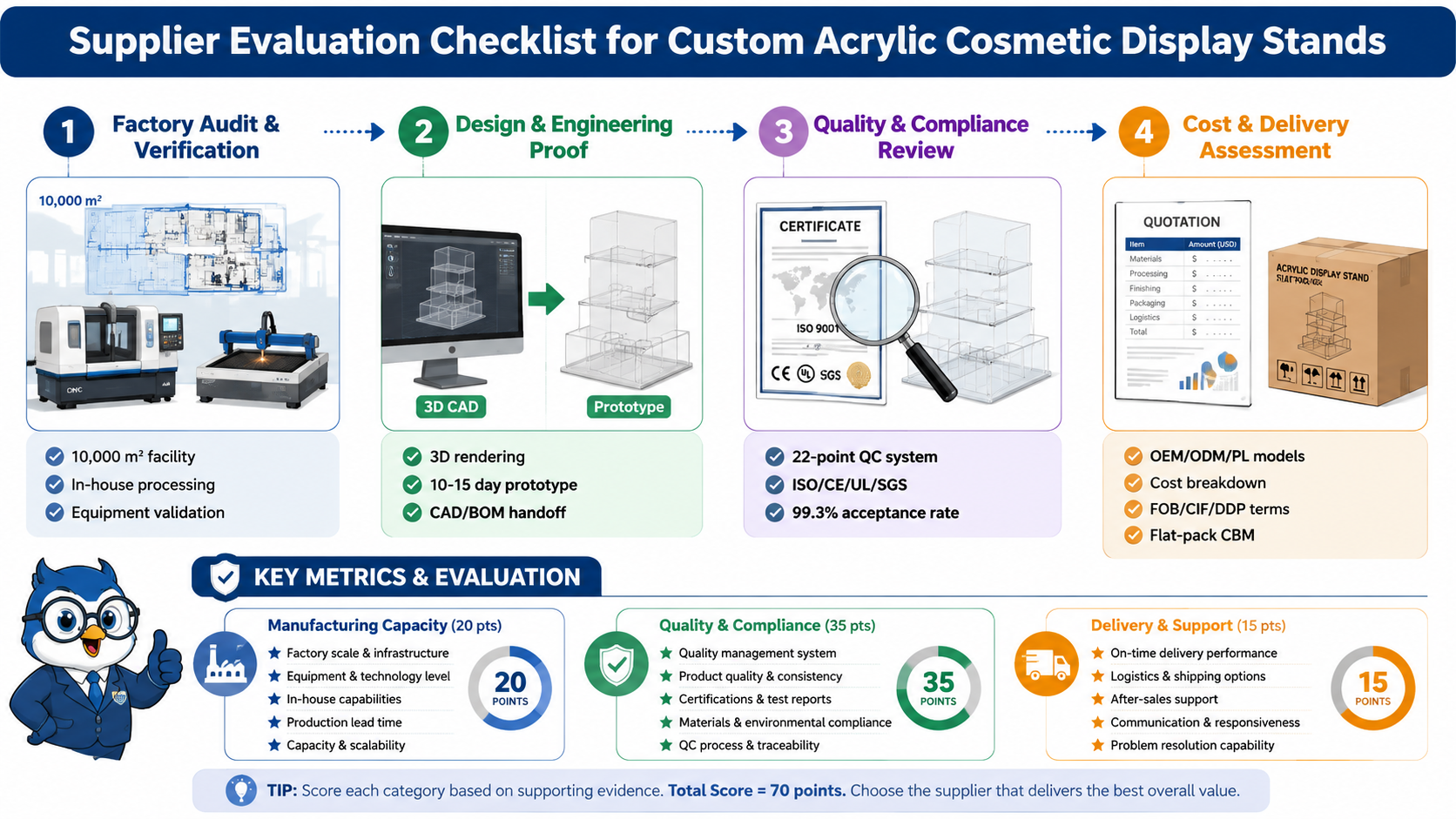
The strongest supplier checklist converts each procurement question into a documentable output: factory proof, engineering files, quotation logic, QC evidence, compliance documents, and delivery data.
Factory Audit 10,000 m² Design Proof 3D + Prototype Cost Model OEM / ODM / PL QC Review 22-Point Check Compliance Pack ISO / CE / UL / SGS Packaging + CBM Flat-pack rollout Shipping Terms FOB / CIF / DDP Retail Approval Launch-ready evidence
Recommended 100-Point Supplier Evaluation Scorecard

Procurement teams can use the following weighting to compare custom cosmetic display manufacturers objectively:
- Factory and process ownership — 20 points: factory size, internal process chain, equipment, production capacity, and outsourcing control.
- Engineering and prototyping — 20 points: 3D rendering, prototype timing, CAD/BOM handoff, SKU fit, structural validation, and IP protection.
- Quotation transparency — 15 points: cost breakdown, MOQ logic, mold cost, packaging, LED, lock, freight, and trade-term clarity.
- Quality control — 20 points: process inspection, pre-shipment inspection, material verification, acrylic processing quality, and QC reporting.
- Certification and retailer compliance — 15 points: ISO, CE, UL, PSE, RCM, FSC, SGS, material reports, retailer documents, and annual renewal.
- Packaging and global delivery — 10 points: CBM control, breakage prevention, flat-pack design, installation documents, phased shipment, and country adaptation.
If the supplier cannot provide evidence in each category, the project risk remains hidden until sample rejection, retailer refusal, shipment damage, customs delay, or store installation failure. Hiledisplay’s role is to make each risk visible before the purchase order becomes a rollout problem.
Request Your Custom Supplier Evaluation Evidence Pack
Key Takeaways & FAQs
Core Insights
- Hiledisplay delivers supplier verification value by combining a 10,000-square-meter factory, in-house acrylic processes, and global beauty retail experience.
- Hiledisplay’s design-to-production capability solves concept-to-rollout risk through 3–5 rendering rounds, 10–15 day prototypes, CAD files, and BOM handoff.
- Procurement must verify QC reports, certification currency, packaging data, and delivery terms to de-risk retailer rejection, rework, breakage, and rollout delay.
Frequently Asked Questions
What factory evidence should buyers check when evaluating a supplier like Hiledisplay?
Buyers should verify factory address, factory size, core equipment, internal process chain, production lines, and relevant project history. Hiledisplay’s 10,000-square-meter Shenzhen factory, CNC, laser cutting, LED line, surface finishing, QC team, and 30 years of cosmetic display manufacturing experience provide concrete evidence of manufacturing capacity. Reference: Hiledisplay factory capability evidence.
Why should Hiledisplay’s 22-point QC system be included in supplier scoring?
Hiledisplay’s 22-point QC system should be scored because it shows quality control across production steps and pre-shipment checks, not just final appearance. Its stated 99.3% first-shipment acceptance rate helps buyers reduce batch variation, rework, replacement shipments, and store installation failure.
How do Hiledisplay’s certification documents help procurement teams pass internal approval?
Certification documents give procurement, legal, quality, and retail-channel teams a verifiable basis for supplier approval. Hiledisplay maintains ISO 9001, ISO 14001, CE, UL, PSE, RCM, FSC, SGS, and retailer-specific documentation, helping reduce delays caused by missing compliance files. Reference: Hiledisplay certification documents.
Why are Hiledisplay’s OEM, ODM, and Private Label capabilities important evaluation criteria?
They show whether the supplier can support different project maturity levels, from production-ready drawings to low-MOQ brand launches. OEM fits buyers with completed CAD files, ODM fits brands needing engineering design support, and Private Label supports faster retail testing with lower development risk.
What should a supplier quotation separate for easier internal approval?
A supplier quotation should separate unit price, mold cost, sample cost, logo process, packaging, LED, locks, freight, taxes, and trade terms. Hiledisplay can break down project configurations so buyers can explain cost sources internally instead of comparing only the final total.
How can buyers evaluate whether a supplier can protect confidential brand designs?
Buyers should check NDA practice, in-house processing ratio, mold ownership, file control, and whether molds are shared with other brands. Hiledisplay’s ODM arrangement supports NDA protection, engineering IP authorization to the brand, brand-owned mold accounts, and no shared mold use.
How should procurement teams verify acrylic material and processing quality?
They should check material type, thickness, tolerance, transparency, edge finish, bonding clarity, cleaning resistance, and yellowing risk. Hiledisplay’s laser cutting, CNC, heat bending, diamond polishing, PMMA processing, UV printing, screen printing, and final assembly support more consistent retail-grade display quality.
How can buyers judge whether a supplier can handle LED or lockable configurations?
Buyers should verify electrical certifications, low-voltage design, LED lifetime, driver protection, lock type, wiring, and pre-shipment testing. Hiledisplay’s LED cosmetic displays, lockable display cases, RFID lock options, 12V DC systems, and department-store or duty-free display experience show complex engineering capability.
Why should packaging and CBM be part of supplier delivery evaluation?
Packaging and CBM directly affect breakage rate, ocean freight cost, warehousing, handling, and store assembly efficiency. Hiledisplay’s flat-pack packaging, self-assembly structures, freight coordination, and rollout packaging adaptation help buyers control landed cost and reduce installation risk.
What is a supplier evaluation checklist?
A supplier evaluation checklist is a standardized tool for verifying factory, design, quotation, quality, compliance, documentation, and delivery capability before placing an order. It turns scattered inquiry questions into comparable procurement evidence, helping buyers avoid decisions based only on price, catalog images, or sample appearance.