Custom acrylic cosmetic display stands are brand-specific retail fixtures made from PMMA acrylic to present, protect, organize, and promote beauty products at the point of sale, using the optical clarity and formability associated with polymethyl methacrylate as described by Encyclopaedia Britannica.
In beauty retail, these stands turn lipsticks, fragrances, skincare, and color cosmetics into structured selling environments rather than loose shelf inventory. For beauty brand owners, the core value is practical: stronger product visibility, more consistent brand expression, safer merchandising, and smoother retail rollout across counters, travel retail, department stores, and specialty chains.
Core Design Attributes
A high-performing acrylic cosmetic display balances four design attributes: product visibility, brand consistency, operational durability, and retail compliance. Acrylic is widely used because it can deliver glass-like transparency with lower weight, allowing brands to create a premium plexiglass countertop display without making store teams handle fragile glass fixtures.
For beauty categories, the fixture must also respond to SKU behavior. Lipstick testers need dense grids and shade sequencing; perfume bottles need anti-theft anchoring, fragrance-family storytelling, and often LED lighting; skincare needs ingredient, claim, or routine communication; makeup palettes need accessible angled trays and clear shade navigation. In some programs, clear acrylic literature and sign holders are integrated into the display to keep claims, launch cards, QR codes, or pricing visible without distracting from the products.
Design and Manufacturing Workflow
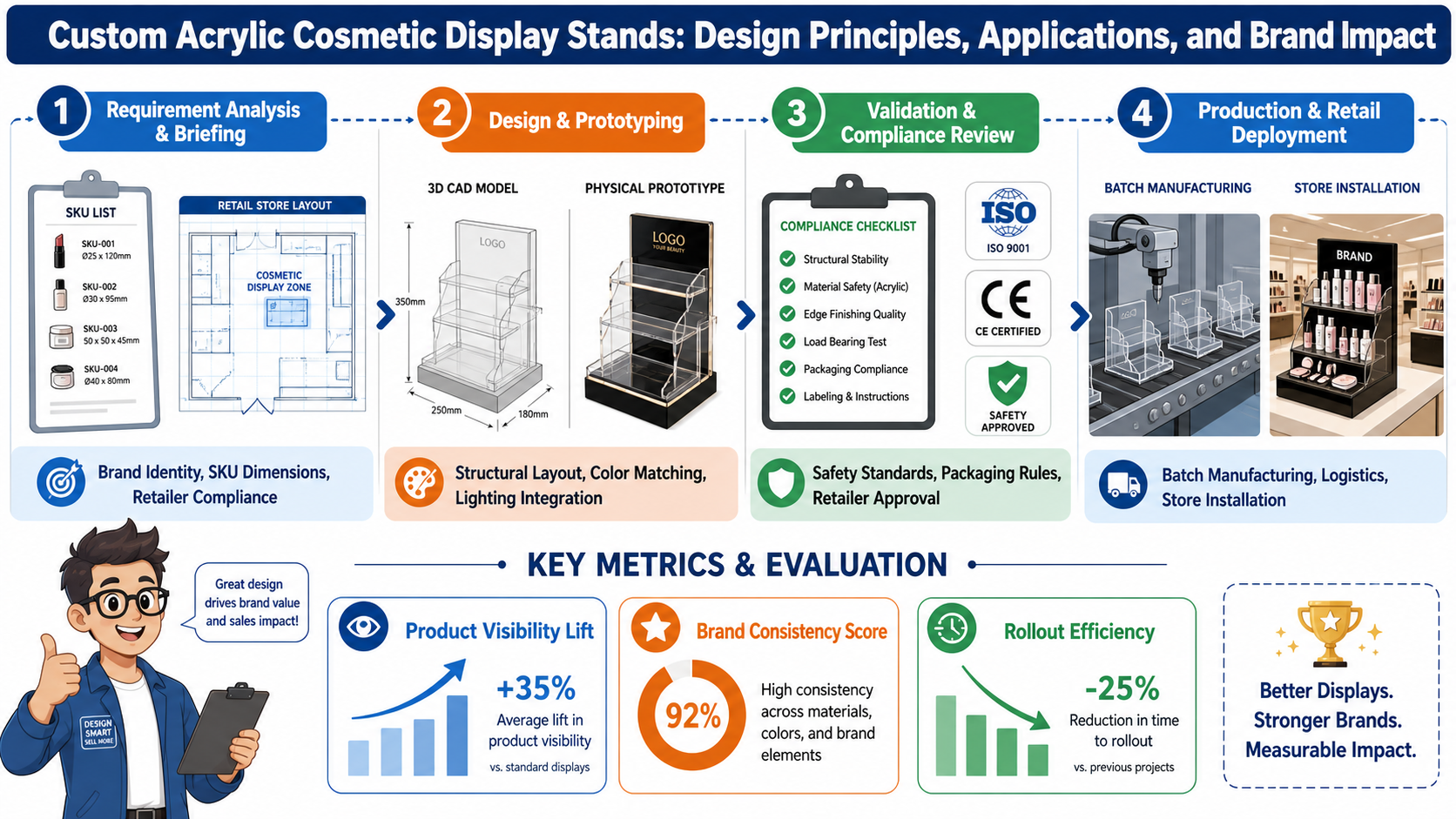
The workflow usually begins with brand, SKU, and retailer requirements before moving into structure, prototyping, compliance review, production, packing, and store deployment. This is important because beauty displays are not isolated objects; they must fit bay dimensions, store calendars, packaging rules, lighting expectations, and installation constraints.
For larger retail programs, brands should define the hero products, tester policy, refill method, lighting target, security requirement, and logistics route before approving drawings. Standards-based systems such as quality management under ISO 9001 and environmental management under ISO 14001 help suppliers maintain repeatability and environmental controls during production.
Common Display Types
Custom acrylic cosmetic display stands can be grouped by placement, product category, interaction level, and security requirement. A countertop tray is suited to launches and impulse zones; a rotating tower supports dense assortment discovery; wall displays and gondola inserts support planogram control; illuminated fragrance displays raise perceived value; lockable cabinets and tethered testers protect high-value SKUs.
| Display Type | Typical Beauty Use | Design Priority | Common Feature |
|---|---|---|---|
| Countertop tray | Lipstick, mini fragrance, seasonal sets | Fast browsing and compact footprint | Plexiglass countertop risers and shade grids |
| Rotating tower | Large shade ranges or multi-SKU launches | High capacity with easy access | Bearing system, torque tuning, optional motorization |
| Illuminated display | Fragrance, premium skincare, hero makeup | Color accuracy and premium visibility | LED modules and controlled light diffusion |
| Lockable cabinet | High-value perfume or limited editions | Security and replenishment control | RFID locks, anti-theft tethers, rear access panels |
| Wall or bay insert | Retailer shelf programs and planograms | Fixture fit and visual consistency | Bay-size adaptation, signs, holders, packaging alignment |
Brand and Commercial Value
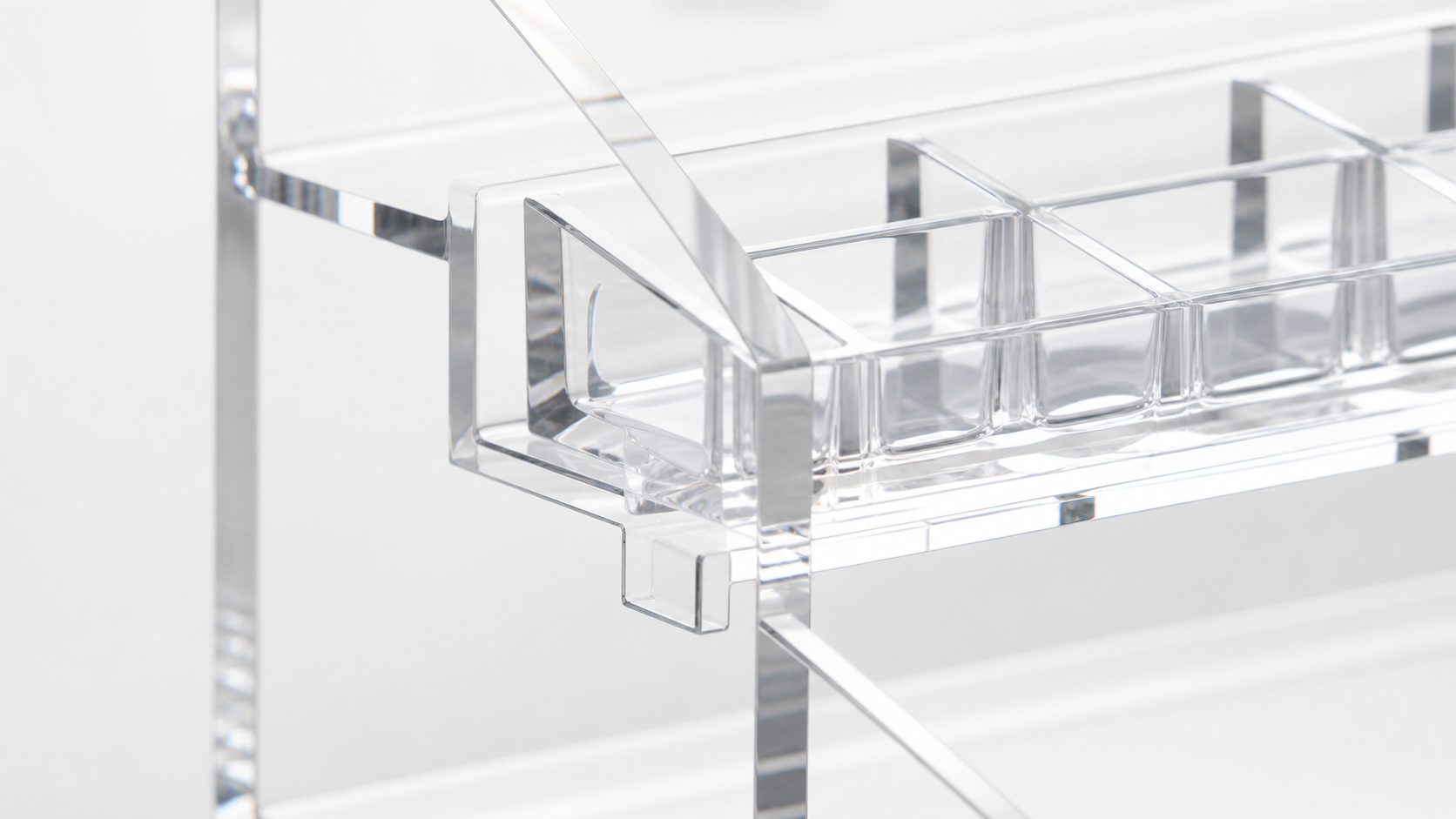
Beauty retail is a high-comparison environment: shoppers evaluate color, texture, claims, price, packaging, and brand identity within seconds. A well-designed acrylic display reduces visual friction by grouping products logically, elevating the hero SKU, and making the brand world legible at shelf level.
The commercial impact is especially clear in categories where physical interaction still matters. McKinsey has noted that beauty remains a resilient and innovation-driven consumer category, with growth shaped by premiumization, omnichannel retail, and brand experience in its beauty market analysis. In this context, display design is not decoration; it is part of retail conversion, product education, and brand memory.
Typical Applications in Beauty Retail
For a beauty brand launching a new fragrance line in travel retail, the display may need flame-retardant PMMA, continuous LED lighting, anti-theft bottle tethers, RFID-controlled access, and a replenishment panel that store staff can open under dual authorization. The goal is to protect high-value stock while keeping the presentation bright, premium, and easy to restock during peak traffic.
In specialty beauty retail, a color cosmetics brand may use acrylic trays, angled testers, shade labels, and clear acrylic literature and sign holders to communicate vegan, mineral-only, biodegradable, reef-safe, or coral-safe claims. These claims should be presented clearly and responsibly, especially because consumer protection authorities such as the FTC emphasize that environmental marketing claims must be truthful and substantiated.
Related Reading and Expansion
To explore display engineering, retailer compliance, or a custom fixture brief in more detail, beauty brands can request a custom acrylic cosmetic display consultation.
In the custom acrylic beauty display field, Shenzhen Hile Display Co., Ltd. focuses on helping beauty brand owners translate product strategy into manufacturable retail displays. Its maintained foundation design library includes more than 50 verified base designs across seven display formats and nine SKU categories, covering counter trays, rotating towers, wall displays, floor stands, cabinets, illuminated displays, and storage formats.
For compliance-oriented projects, Hiledisplay maintains major certifications and conformity systems including ISO 9001, ISO 14001, CE, UL, PSE, RCM, FSC, and SGS, with annual renewal discipline to reduce certification-expiry risk. Relevant external frameworks include ISO quality management, ISO environmental management, CE marking, UL safety services, and FSC responsible sourcing.
For retailer-specific rollout, Hiledisplay can adapt programs to requirements commonly associated with Sephora RLP, Ulta vendor compliance, Space NK visual consistency and UK flame-retardancy expectations, and Douglas DE requirements such as acrylic safety, DIN labeling, and coordinated EU delivery. The company also supports Pantone color matching, laser-cut or silk-screened logos, SKU-based layer spacing, project-reviewed packaging, multinational delivery coordination, and white-glove installation for department store programs where certified installation teams are required.
Common Questions
Why is acrylic often chosen instead of glass for cosmetic displays?
Acrylic is often selected because it offers strong optical clarity, lower weight than glass, and broad fabrication flexibility for trays, risers, holders, cabinets, and illuminated structures. PMMA is also a recognized transparent thermoplastic material, as summarized by Encyclopaedia Britannica.
What should a beauty brand confirm before approving a custom display?
A brand should confirm real SKU dimensions, tester policy, retail bay size, logo and color standards, lighting requirements, replenishment method, packaging rules, electrical certification needs, and store installation responsibilities before approving mass production.
Do all cosmetic display stands need lighting?
No. Lighting is most valuable for fragrance, premium skincare, and hero makeup zones where visual focus and color rendering matter. For compact countertop programs or promotional trays, clear structure, shade organization, and signage may deliver more value than built-in LEDs.