Planogram drift starts small. A lipstick tray moves, a tester slot opens, a shade label is replaced by hand, and soon the cosmetics wall no longer matches the approved retail plan.
For retail operations leaders, visual merchandising managers, and beauty brand teams, this is not just a display problem. It can reduce sales clarity, raise labor cost, weaken brand control, and make store audits harder. This article explains why a modular acrylic merchandising blueprint from Hiledisplay can help keep Cosmetics Wall Systems aligned, flexible, and easier to manage at scale.
Why Planogram Drift Becomes a Business Problem
A planogram is a visual map that tells each store where every SKU, tester, label, and brand block should sit. In beauty retail, that map changes often. New shades launch. Seasonal kits arrive. Fragrance bottles change size. Skin care brands add new pack formats.
When the wall system cannot adapt, store teams start to improvise. They move trays. They tape labels. They leave empty spaces. These small fixes create drift.
The business cost is real. NielsenIQ reports that in-store beauty sales remain a major channel, even as online sales keep growing. This means the physical beauty wall still matters. It must make choice simple and trust clear.
POPAI, a long-standing point-of-purchase industry body, also highlights the role of in-store displays in converting browsers into buyers through its shopper engagement research. The key point is simple. The shelf is not passive. It helps the shopper decide.
| Drift Problem | What Store Teams See | Business Impact | Decision Pressure |
|---|---|---|---|
| SKU slots no longer match the planogram | Products sit in the wrong shade or category order | Lower shopper confidence and slower product finding | More audit findings and more follow-up work |
| Tester areas become mixed | Open testers and sellable stock share the same space | Messy presentation and higher hygiene concern | More store team coaching and replacement cost |
| Launch updates require full fixture changes | Teams wait for new parts or use temporary fixes | Delayed campaign execution | Higher risk of missing launch dates |
| Labels and price strips move out of place | Shade names, claims, and prices become unclear | More shopper questions and more staff time | More pressure on store labor budgets |
| Displays differ by market | Stores in different regions look inconsistent | Weaker brand control across markets | Harder global rollout management |
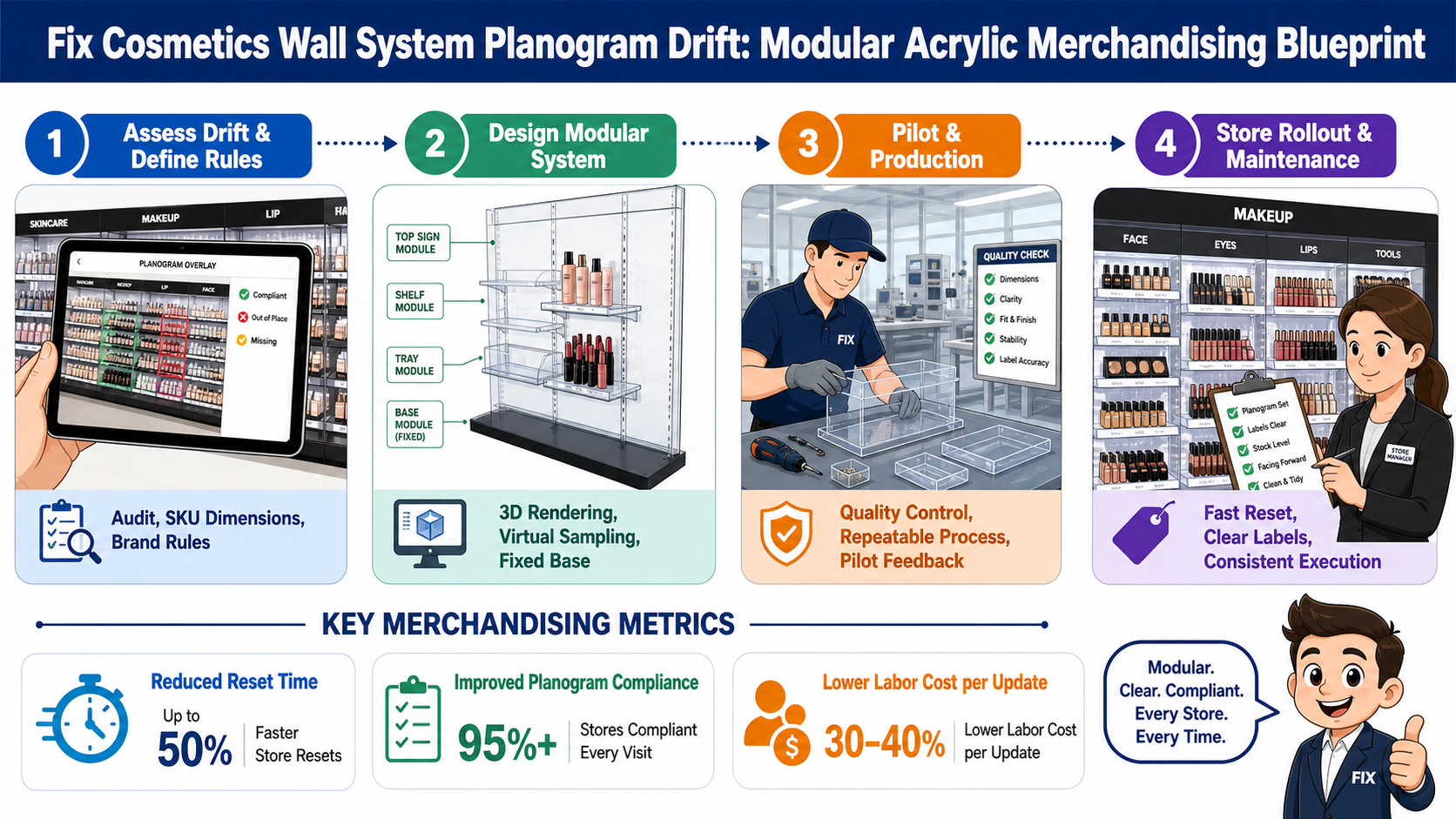
The Modular Acrylic Merchandising Blueprint
A modular acrylic merchandising blueprint is a planned system of interchangeable display parts. It is built before production starts. It defines the wall structure, product bays, tester zones, shelf heights, label areas, brand panels, and update rules.
In simple terms, it works like building blocks. The wall has a fixed base. The trays, holders, shelves, pushers, and graphic panels can change when the range changes. This keeps the planogram stable without forcing a full rebuild.
Hiledisplay is well suited to this approach because the company was founded by acrylic engineers in Shenzhen in 1996. It has stayed focused on custom acrylic displays for beauty retail, including lipstick, perfume, skin care, and color cosmetics. This long focus matters. Cosmetics display work needs more than a general shelf. It needs a close fit between product size, shopper reach, brand image, and store reset speed.
How the System Reduces Drift
The solution is not one single fixture. It is a full merchandising control method. Each part has a clear job. Each part supports the planogram instead of fighting it.
Fixed Reference Points Keep the Wall Aligned
The first cause of drift is a lack of fixed points. If trays can move freely, the planogram depends on store memory. That is risky.
A modular acrylic system can use fixed back panels, locator holes, rail positions, and repeatable shelf slots. These details guide store teams. They show where each module should go. The display itself becomes a physical instruction sheet.
This reduces training time. It also reduces the chance that a busy store team places a product block in the wrong location.
Interchangeable Modules Make Assortment Changes Easier
Beauty ranges change fast. A lipstick family may add five new shades. A perfume line may add a travel size. A skin care brand may add a refill pack.
Traditional custom displays often handle these changes poorly. They may need new tooling, full replacement, or hand-made store fixes. A modular blueprint avoids this. It separates the base wall from the changing product modules.
Hiledisplay supports this through design, manufacturing, surface treatment, and quality control teams in a 10,000 square meter factory. This gives the project team room to plan a full family of parts, not just one display unit.
3D Rendering and Virtual Sampling Reduce Approval Risk
Planogram drift often begins before store launch. If the buyer, brand team, fixture maker, and retailer do not see the same final layout, errors appear later in stores.
Hiledisplay uses 3D rendering and virtual sampling to improve design and development speed. This helps teams review product spacing, logo position, lighting zones, and shopper reach before physical production.
This is important for global beauty rollouts. A small mistake repeated across many stores becomes expensive. Early visual checks help prevent that.
Clear Label Zones Support Better Product Data
Planograms depend on clean product data. GS1 includes planogram image and data field specifications in its Product Image Specification Standard. This shows that product presentation, image rules, and planogram data are connected.
Acrylic fixtures can support this connection through defined label strips, shade name windows, price holders, QR code panels, and tester tags. When these zones are fixed, stores have fewer reasons to improvise.
For labels that need long-term durability, UL Solutions explains that its Marking and Labeling Systems Program covers label materials and marking performance requirements. Beauty fixtures do not always need safety labels, but the principle is useful. Labels should stay readable, attached, and fit for their environment.
Blueprint Features Mapped to Retail Pain Points
A strong solution must map each pain point to a clear feature. It must also show the business result. The table below explains the logic.
| Retail Pain Point | Blueprint Feature | How It Works | Business Value |
|---|---|---|---|
| Stores do not follow the approved planogram | Fixed locator system | Modules fit into defined positions on the wall | More consistent execution across stores |
| Frequent product launches create chaos | Interchangeable trays and shelves | Only the needed module changes, not the full wall | Lower update cost and faster launch support |
| Brand blocks look uneven across markets | Custom acrylic brand panels | Color, finish, logo, and product zones are designed as one system | Stronger brand expression and cleaner shopper experience |
| Store teams spend too much time resetting displays | Simple modular reset logic | Parts are easy to remove, replace, and check | Lower labor pressure and easier field audits |
| Buyers worry about scale and repeat supply | Integrated design and manufacturing | Design, production, surface treatment, and QC work together | Better control from sample to rollout |
| Sustainability goals are rising | Recycled acrylic and water-based surface treatment options | Material and finish choices can support greener fixture programs | Better fit with modern retail sourcing goals |
Why Acrylic Is a Strong Fit for Beauty Walls
Acrylic is widely used in beauty retail because it is clear, smooth, and easy to shape. It can show color cosmetics without hiding the product. It can also support premium surface finishes for fragrance and skin care brands.
For a cosmetics wall, acrylic brings four practical benefits.
- It gives clear product visibility, which helps shoppers compare shades and pack forms.
- It can be formed into precise trays, risers, tester wells, and dividers.
- It supports clean brand graphics through printing, bonding, and surface finishing.
- It can be designed as replaceable modules, which helps future range changes.
The best result comes when acrylic is not treated as a simple material choice. It should be part of the planogram system. Hiledisplay’s long focus on custom acrylic beauty displays supports this approach. The company understands that lipstick, perfume, skin care, and makeup each need a different display logic.
Why Modularity Beats One-Time Custom Fixtures
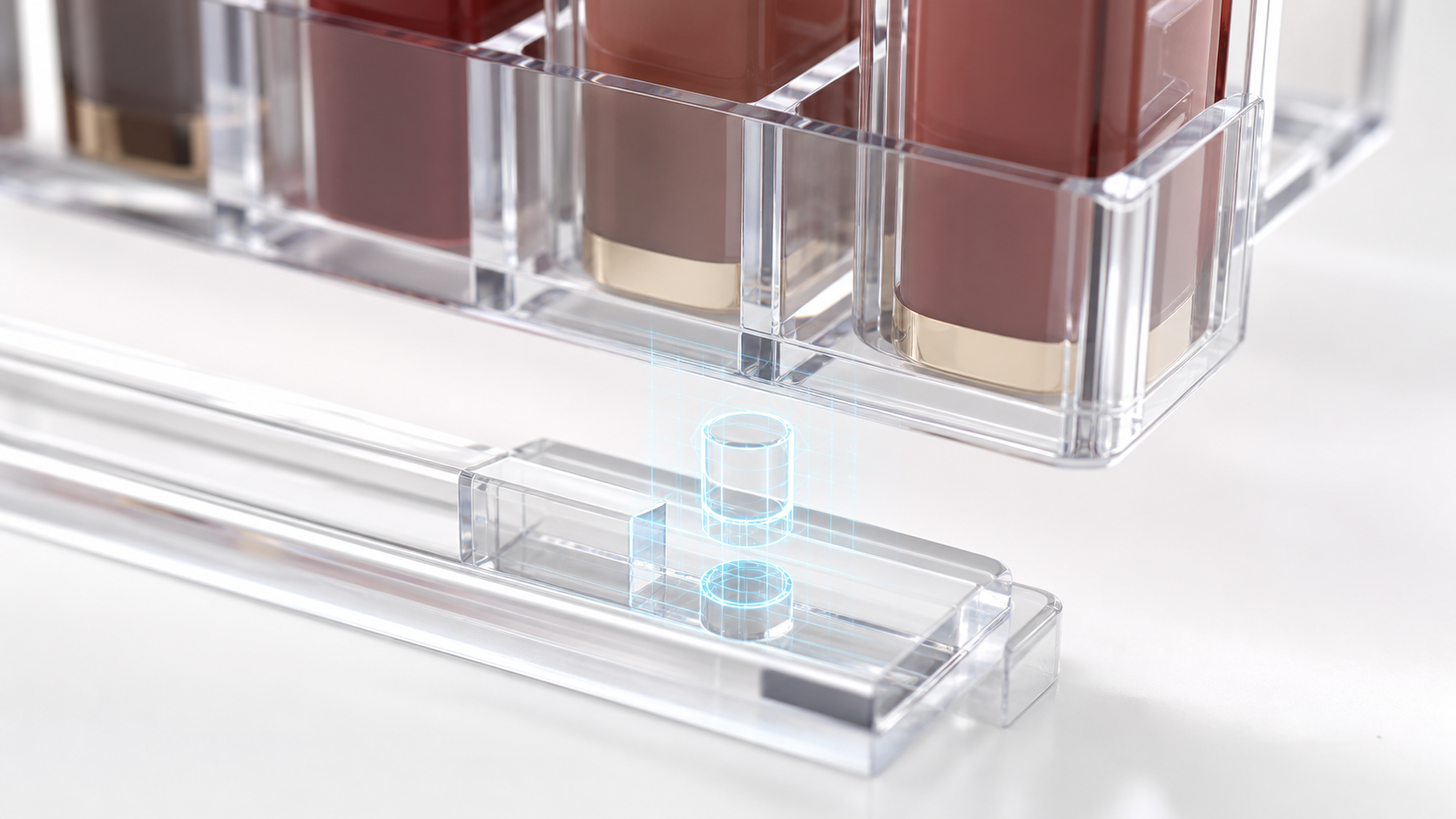
One-time custom fixtures can look good on launch day. The problem comes later. Beauty retail changes quickly, but fixed displays do not.
A modular system gives the buyer more control over time. It lets the brand keep the core wall while updating product zones. It also makes it easier to support different store sizes and regional ranges.
This matters because the beauty market continues to grow and shift. McKinsey notes that the global beauty market is expected to keep growing and reach major scale by 2030 in its state of beauty analysis. Growth brings more launches, more channel choices, and more pressure on store execution.
Modularity helps the display keep pace with this market. It turns a fixture from a fixed cost into a flexible retail asset.
Authoritative Principles Behind the Solution
The modular acrylic blueprint is practical because it follows several proven principles. These principles are not limited to beauty retail. They come from quality, ergonomics, product data, and circular design.
Quality Control Reduces Variation
ISO explains that quality management principles include customer focus, process approach, and continual improvement in its quality management guidance. For retail displays, this means the supplier should not only make attractive parts. It should control how each part is designed, produced, checked, and repeated.
Hiledisplay’s integrated team covers design, manufacturing, surface treatment, and quality control. This supports the same idea. A repeatable process reduces variation between the approved sample and the final store rollout.
Ergonomics Supports Better Shopper Use
Ergonomics means designing things around how people see, reach, and use them. ISO 9241 covers human-system interaction principles, and ISO 9241-110 focuses on interaction principles.
A cosmetics wall is also a human interaction system. Shoppers scan shades. They pick up testers. Staff refill stock. If the wall is hard to use, people create workarounds. Workarounds cause drift.
A good acrylic blueprint uses height, spacing, hand access, and label position to make the right action easy. This is why human-centered design is not just a design phrase. It protects execution.
Structured Product Information Keeps Displays Accurate
GS1 standards show the importance of consistent product images and planogram fields. For beauty retail, this supports better matching between product data, shelf space, and shopper-facing labels.
When product data and fixture design are aligned, each SKU has a clear home. This reduces confusion during resets and audits.
Circular Design Supports Long-Term Retail Programs
Sustainability is now part of many fixture decisions. The Ellen MacArthur Foundation describes circular economy as a system that keeps products and materials in use for longer in its circular economy overview.
For beauty displays, modularity supports this idea. If only a tray or graphic panel changes, the main wall can stay in use. Hiledisplay has also introduced recycled acrylic and water-based surface treatment projects. These options can help buyers explore more responsible display programs.
What Makes Hiledisplay’s Approach Credible
Many suppliers can make acrylic parts. Fewer can package those parts into a complete beauty retail execution system.
Hiledisplay brings several useful strengths to this problem.
- It was founded in 1996 by acrylic engineers, giving it a long technical base.
- It focuses on beauty retail display scenarios, not general fixtures only.
- Its work covers lipstick, perfume, skin care, and makeup display needs.
- Its 10,000 square meter factory supports design, production, finishing, and quality control.
- Its products have entered more than 120 countries and regions, showing broad delivery experience.
- It uses 3D rendering and virtual sampling to improve early project decisions.
These points matter because planogram drift is a system problem. It needs engineering accuracy, beauty category knowledge, manufacturing control, and global rollout support. Hiledisplay’s business focus connects these needs in one supplier model.
Implementation Path for Buyers and Retail Teams
Adopting a modular acrylic wall system should be managed in stages. This keeps risk low and makes the decision easier to approve.
Assess the Current Drift
Start with a small audit. Compare the approved planogram with real store photos. Mark where products, labels, testers, and brand blocks have moved.
Useful inputs include SKU dimensions, tester sizes, current fixture photos, launch calendar, store count, regional range differences, and audit notes.
Define the Modular Rules
Next, decide which parts should stay fixed and which parts should change. The base wall, brand header, and main rails may stay fixed. Product trays, testers, shade strips, and seasonal panels may change.
This step is important. Modularity without rules can still create disorder. The goal is controlled flexibility.
Use 3D Review Before Physical Sampling
A 3D review helps teams see the wall before tooling and production. It can show product density, shopper reach, logo balance, and shelf rhythm.
This stage is useful for procurement teams because it lowers approval risk. It also helps brand teams avoid late design changes.
Run a Pilot Before Full Rollout
A pilot store or pilot market can test reset speed, product fit, label clarity, and store team feedback. The result should guide final production changes.
After the pilot, the buyer can confirm packaging, installation guides, spare module needs, and rollout schedule.
| Stage | What to Prepare | Key Question for the Supplier |
|---|---|---|
| Initial review | Store photos, current planogram, product list | Can you identify the main drift points before design starts? |
| Concept design | Brand rules, launch needs, fixture size limits | Can the system separate fixed parts from changeable modules? |
| Virtual sampling | SKU dimensions, label content, tester rules | Can we review the wall in 3D before physical sampling? |
| Pilot | Target stores, reset process, audit criteria | How will feedback be turned into production updates? |
| Rollout | Store count, shipping plan, spare parts plan | How do you control quality across repeat production? |
FAQ
What is planogram drift in a cosmetics wall system?
Planogram drift means the real display no longer matches the approved product layout. It often happens when products, testers, labels, or trays move over time.
Why does drift happen more often in beauty retail?
Beauty ranges change often. New shades, testers, seasonal items, and packaging sizes make the wall harder to keep stable.
How does a modular acrylic display reduce drift?
It gives each product zone a clear place. It also lets teams replace only the needed module when the assortment changes.
Is modular design only for large retail chains?
No. It also helps growing brands and regional retailers. The key benefit is control. Teams can keep the same display logic while changing product groups.
Why work with Hiledisplay for this type of project?
Hiledisplay has focused on custom acrylic beauty displays since 1996. It combines design, manufacturing, surface treatment, quality control, 3D rendering, and global delivery experience.
Conclusion: Turn the Beauty Wall Into a Controlled System
Planogram drift is not only a store problem. It is a design, data, fixture, and execution problem. A modular acrylic merchandising blueprint solves it by giving each SKU, tester, label, and brand zone a stable home.
Hiledisplay brings the right mix of acrylic engineering, beauty retail focus, manufacturing scale, virtual sampling, and global delivery experience. This makes it a strong partner for brands, retailers, and fixture buyers who want more reliable Cosmetics Wall Systems.
If your beauty wall is becoming harder to control, start with a structured review. Share your planogram, product list, and store photos with Hiledisplay to explore a better system through a project consultation.