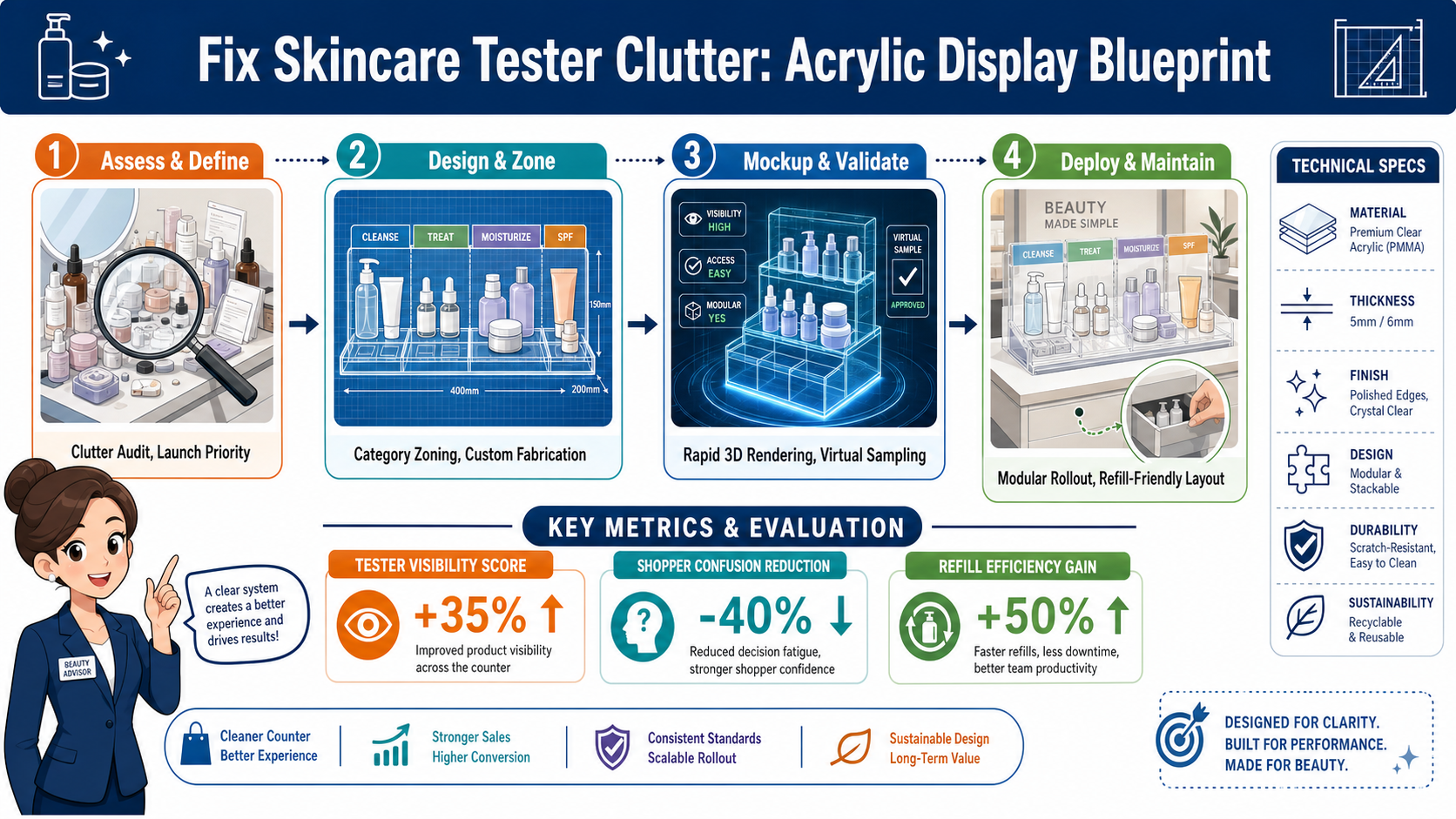
Skincare launches often fail at the beauty counter for a simple reason. Testers move, refill packs pile up, labels face the wrong way, and the premium shelf starts to look busy instead of beautiful.
This article explains why a modular acrylic tester display system can fix that problem. The solution combines custom fabrication, category zoning, refill-friendly layouts, rapid sampling mockups, and a clear Beauty Counter Visual Merchandising Blueprint.
Why Skincare Tester Clutter Is a Business Problem
For a beauty retail team, tester clutter is not only a visual issue. It can slow the launch, confuse shoppers, and make the brand look less premium.
The risk is larger because beauty retail is still growing. McKinsey reports that the global beauty market could reach about $580 billion by 2027. That means more launches, more SKUs, and more pressure on shelf space.
NIQ also notes that beauty shoppers still need physical retail for discovery. NIQ describes sampling, product trial, and guided expertise as key parts of prestige beauty discovery. If testers are hard to see, the counter loses one of its strongest sales tools.
| Counter Problem | Daily Effect | Business Risk | Decision Maker Pressure |
|---|---|---|---|
| Testers are hidden by boxes or refill stock | Shoppers do not try the hero product | Lower launch conversion | Marketing spend is harder to defend |
| Categories are mixed together | Serum, cream, toner, and SPF look similar | More shopper confusion | Beauty advisors need more time to explain |
| Fixture sizes do not match product packs | Bottles lean, rotate, or fall | Premium image is weakened | Store teams spend more time fixing displays |
| No refill path is built into the display | Back stock enters the selling area | Counter becomes messy during peak hours | Operations teams face repeated reset work |
What a Modular Acrylic Tester Display System Does
A modular acrylic tester display system is a counter display built from planned blocks. Each block has a clear job. One block may hold hero testers. Another may hold sample sachets. Another may hold refill stock hidden from the shopper view.
This is where an experienced Acrylic Cosmetic Display Stand manufacturer matters. The goal is not just to make a clear plastic stand. The goal is to turn a beauty launch plan into a stable retail tool.
Hiledisplay fits this role because it has focused on custom acrylic beauty displays since 1996. The company was founded in Shenzhen by acrylic engineers. Its work covers skincare, lipstick, fragrance, and makeup retail display needs.
The company now operates with a 10,000 square meter factory. Its team covers design, manufacturing, surface treatment, and quality control. Its products have reached more than 120 countries and regions. These points matter when a brand needs repeatable displays for many stores.
The Beauty Counter Visual Merchandising Blueprint
The blueprint is the plan behind the fixture. It tells the display what to show first, where each tester sits, how refill stock moves, and how the brand story stays clear.
Think of it like a city map for the counter. If the roads are clear, people can move easily. If the zones are clear, shoppers can understand the skincare line faster.
How the Solution Maps to Real Counter Pain Points
Tester Visibility Improves When Every Product Has a Fixed Home
The pain point is simple. A tester without a fixed home will move. It may end up behind a jar, near a wrong label, or beside the wrong product.
The display feature is custom fabrication. Each tray, riser, slot, and label area is made for the product size. This helps the tester face forward and stay in the right place.
The business value is better shopper flow. A shopper can see the product, read the message, try the texture, and ask a question. The path is short and clear.
Category Zoning Reduces Shopper Confusion
Skincare routines can be hard to understand. A shopper may compare cleanser, essence, serum, cream, and SPF at the same time.
Category zoning means the counter is divided into simple product groups. Each group has its own space, height, and message. This makes the display work like a menu.
This also supports the store team. Beauty advisors can guide shoppers faster because the fixture already tells part of the story.
Refill-Friendly Layouts Protect Premium Shelf Discipline
Refill stock is needed. But it should not take over the tester area. When refills sit beside testers, the counter starts to look like storage.
A refill-friendly layout gives replenishment a hidden or controlled path. It can include rear access, pull-out stock areas, or marked refill zones.
This improves operations. Staff can refill fast without changing the selling face of the display. The customer sees a clean brand world, not a stock room.
Rapid Sampling Mockups Reduce Launch Risk
A skincare launch often changes before final approval. Bottle size, carton height, tester count, and sample pack design may still move.
Hiledisplay supports 3D rendering and virtual sampling. This lets a team review the counter plan before mass production. It can catch size problems, message gaps, and refill issues early.
The value is speed with control. The team can test the idea, adjust the layout, and move toward production with fewer surprises.
| Pain Point | Display System Feature | How It Works | Commercial Value |
|---|---|---|---|
| Low tester visibility | Custom acrylic trays and risers | Each SKU keeps a clear front-facing position | More trial chances for hero skincare items |
| Mixed product story | Category zoning | Routine steps are grouped in a simple order | Faster shopper understanding |
| Messy refill stock | Refill-friendly layout | Stock has a planned access point | Cleaner counter during busy hours |
| Slow launch approval | 3D rendering and virtual mockups | Teams review structure before tooling | Lower rework risk and faster decision making |
| Inconsistent multi-store rollout | Manufacturing and quality control | Fixtures follow the same approved design | More consistent brand image across markets |
Why Acrylic Works Well for Skincare Tester Displays
Acrylic is often used in beauty retail because it gives a clean and bright look. It can be clear, colored, frosted, printed, or shaped for special packs.
The material also supports precision. Precision means the parts fit closely. This is important when small skincare bottles, tubes, jars, and sample cards must stay neat on a tight counter.
Material control matters too. ASTM D788 covers PMMA, the material commonly known as acrylic. Standards like this help buyers understand that acrylic is not one vague material. It has defined material classes and performance expectations.
Retail fixture safety should also be considered. UL Solutions explains safety requirements related to retail fixtures and merchandise displays. For beauty counters, this supports questions about stability, edges, electrical add-ons, and safe use in public spaces.
Why Human-Centered Design Supports Better Beauty Counters
Human-centered design means designing around real people. In this case, the people are shoppers, beauty advisors, visual merchandisers, and store operations teams.
ISO 9241-210 explains human-centered design for interactive systems. A beauty counter is not software, but the same idea applies. The display should fit the way people see, touch, choose, refill, and maintain products.
This is why the best tester display is not only attractive. It must be easy to shop and easy to reset. If a counter is hard to maintain, it will lose order after a few busy days.
Why Modular Design Beats Generic Counter Stands
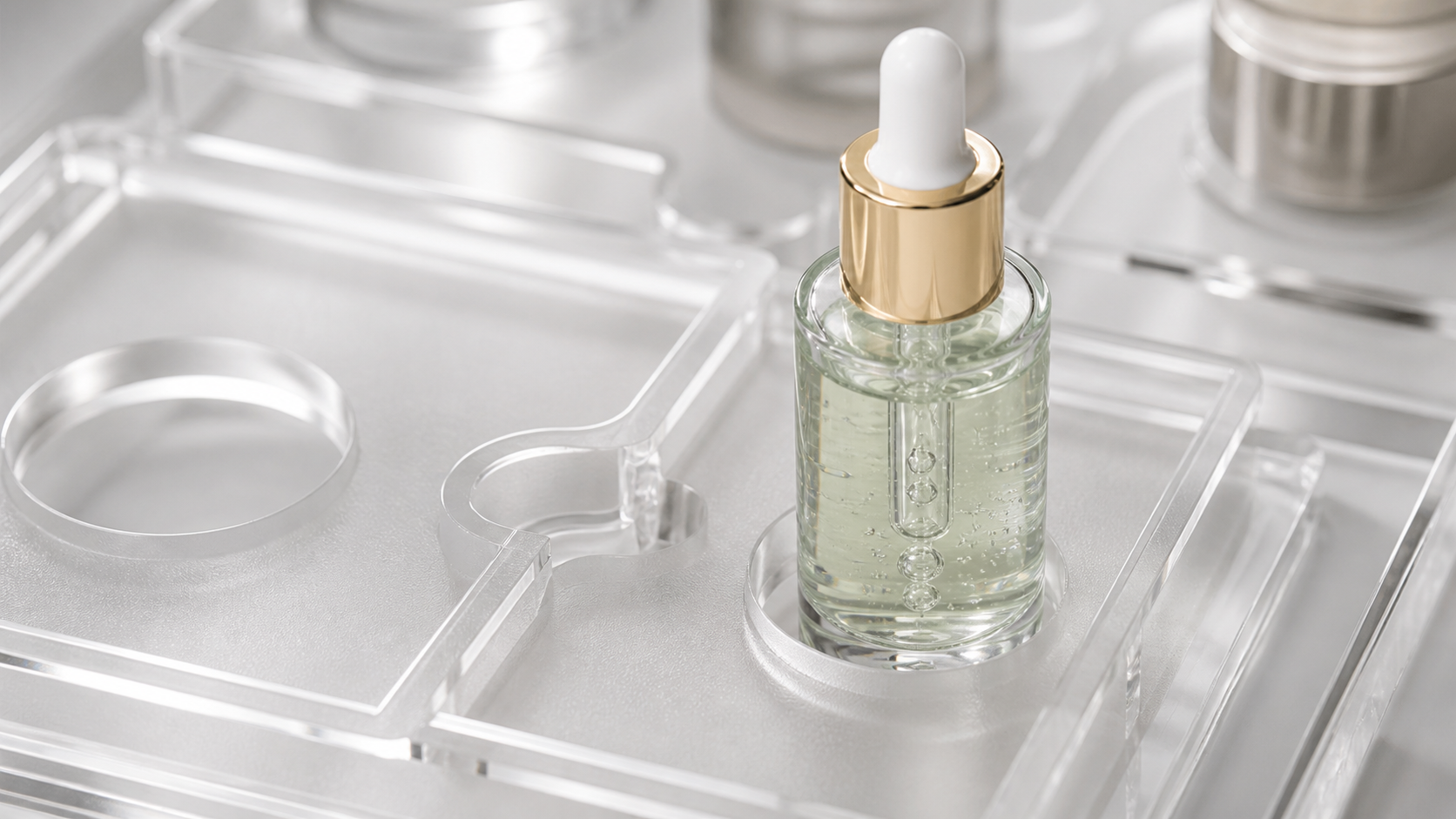
A generic counter stand may look fine on day one. But it often fails when the launch grows, when testers change, or when the store needs a fast refill.
A modular system is different. It can use shared parts, planned zones, and replaceable sections. This gives retail teams more control during launch waves.
| Comparison Area | Generic Counter Stand | Modular Acrylic Tester Display System |
|---|---|---|
| Fit for skincare packs | Often based on standard sizes | Built around real bottle, jar, tube, and sachet sizes |
| Launch changes | Harder to adjust | Sections can be reviewed and changed earlier |
| Brand image | May look similar to other brands | Can match color, shape, logo, and campaign story |
| Refill control | Usually not planned | Refill path can be built into the layout |
| Multi-store rollout | Risk of uneven display quality | Approved structure can be repeated through controlled production |
How Refill Planning Supports Modern Retail Goals
Many beauty brands now look at reuse, refill, and lower-waste systems. A tester display cannot solve the full packaging issue. But it can support better refill behavior at the counter.
The Ellen MacArthur Foundation explains circular design as a way to keep products and materials in use. In retail displays, this idea supports durable fixtures, replaceable parts, and cleaner refill systems.
For skincare launches, the practical benefit is clear. A display that plans refill access can reduce daily mess. It can also help teams separate selling space from stock space.
Implementation Path for Beauty Retail Teams
A strong acrylic tester display project starts with clear information. The better the input, the better the display can fit the real counter.
Assess the Current Counter
Start with photos of the current counter. Include front view, side view, storage areas, and peak-hour clutter. Also list which testers move most often.
Define the Launch Story
Decide which product must be seen first. This may be a hero serum, a new cream, or a routine set. The display should make that priority obvious.
Map the Product Zones
Group products by routine step, skin concern, or price tier. Choose the method that shoppers already understand in your store.
Plan Refill Movement
List what must be refilled each day. Then decide where the stock should sit, who can access it, and how it should stay hidden from the premium selling face.
Review a Mockup Before Production
Use renderings, virtual samples, or fast mockups to test the display. Check tester angle, label reading, product spacing, hand access, and cleaning needs.
Questions to Ask Before Choosing a Display Partner
A display partner should understand beauty retail, not only acrylic cutting. Use these questions during supplier review.
- Can the supplier design around real skincare pack dimensions and tester behavior?
- Can the supplier show 3D renderings or virtual samples before production?
- Can the fixture support refill access without hurting the shopper view?
- Can the supplier repeat the same quality for multi-store rollout?
- Can the supplier support surface treatment, printing, and quality control in one workflow?
- Can the supplier discuss recycled acrylic or water-based surface treatment options when needed?
Why Hiledisplay Is a Strong Fit for This Blueprint
Hiledisplay brings several strengths that match this solution. The company has focused on cosmetic retail displays since 1996. That long focus helps it understand the small details that matter at a beauty counter.
Its 10,000 square meter factory supports design, manufacturing, surface treatment, and quality control. This helps a project move from idea to production with fewer handoff risks.
Its global delivery experience across more than 120 countries and regions also matters. Beauty brands and retailers often need one approved display idea to work in many markets.
Hiledisplay has also improved its design process with a design studio, 3D rendering, and virtual sampling. These tools help teams see the counter before the fixture is made.
The company also explores recycled acrylic and water-based surface treatment projects. This can support buyers who want cleaner material choices without losing premium shelf presentation.
FAQ
What is the main goal of an acrylic skincare tester display?
The main goal is to keep testers visible, stable, and easy to try. It also helps the counter keep a premium and organized look.
Why is modular design useful for beauty counter launches?
Modular design makes the fixture easier to adjust. It helps when product sizes, tester counts, or launch messages change before rollout.
How does category zoning help shoppers?
Category zoning groups products in a clear way. Shoppers can understand the routine faster and compare the right products.
What information should I prepare before contacting Hiledisplay?
Prepare product dimensions, counter size, launch images, tester count, refill needs, brand colors, and target store quantity.
Can acrylic displays support premium skincare branding?
Yes. Acrylic can be shaped, printed, colored, frosted, and combined with lighting or metal accents. This helps the display match a premium brand image.
Conclusion
Skincare tester clutter is not a small store problem. It affects visibility, launch speed, advisor workload, and premium brand trust.
A modular acrylic tester display system solves the issue in a structured way. Custom fabrication fixes product fit. Category zoning improves shopper understanding. Refill-friendly layouts protect shelf order. Rapid mockups reduce launch risk.
Hiledisplay is well placed to support this blueprint. Its long beauty display focus, acrylic engineering base, 10,000 square meter factory, global project experience, and virtual sampling capability give retail teams a practical path from counter problem to finished display.
If your next skincare launch needs cleaner testers, stronger visual order, and a better refill plan, start your acrylic display project with Hiledisplay.