The Production-Ready Prototype Answer: Hiledisplay for Beauty Display Engineering
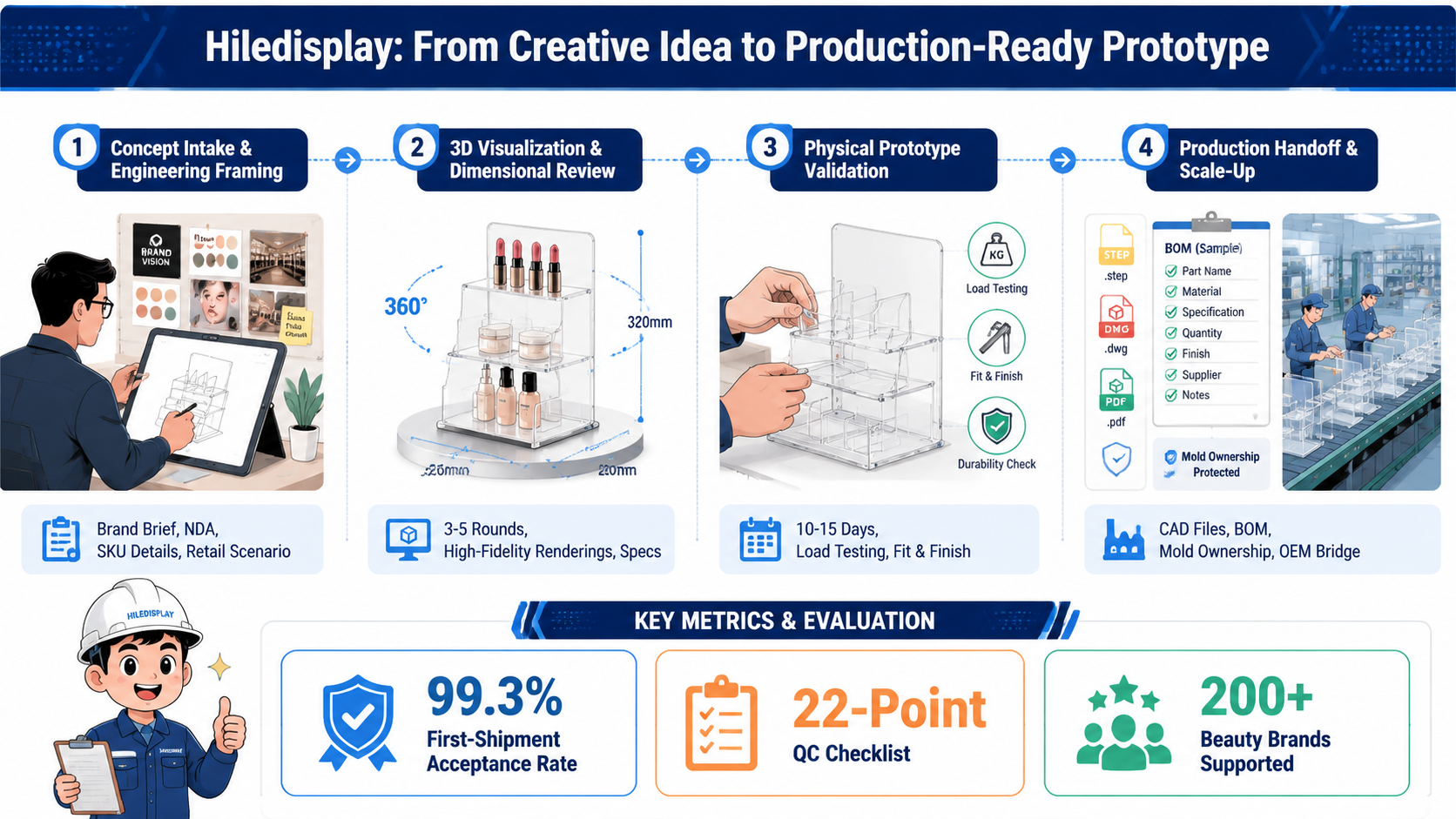
Hiledisplay turns beauty display ideas without production-ready drawings into reviewable, testable, and manufacturable solutions through 3-5 rounds of 3D rendering, 10-15 day physical prototypes, CAD files, and BOM delivery.
This leadership is validated through verifiable evidence across key areas:
- Engineering Visualization: 3-5 rounds of high-fidelity 3D rendering with dimensional specification documents.
- Prototype Validation: physical prototypes can be delivered in 10-15 days before tooling approval.
- Production Handoff: optimized prototypes are converted into CAD files and BOMs for OEM production.
Beauty brands often ask a broad question: “Can you design this from a sketch, photo, or rough retail idea?” Hiledisplay converts that uncertainty into a verifiable engineering pathway: NDA-backed project intake, 3D rendering approval, physical prototype testing, CAD and BOM documentation, and OEM handoff. This makes a custom Acrylic Cosmetic Display Stand prototype easier to approve internally, easier to test with retailers, and easier to scale into production without redesigning the project after sampling.
Why Prototype Engineering Matters Before Retail Rollout
A cosmetic display idea becomes commercially risky when it moves into tooling, retailer submission, or bulk production before the structure is fully validated. Low-detail sketches, reference photos, and visual mood boards may express a brand direction, but they do not confirm SKU fit, load capacity, material thickness, color matching, logo placement, replenishment access, packaging method, or assembly behavior.
Hiledisplay, founded in Shenzhen in 1996 by acrylic engineers, supports beauty brands through custom display design, acrylic fabrication, prototyping, and manufacturing. For a deeper view of its company background and project capabilities, see Hiledisplay’s acrylic cosmetic display manufacturing background. For procurement teams comparing this prototype step within the full supplier validation process, the related guide how to validate a custom acrylic cosmetic display supplier before retail rollout explains how prototype evidence fits into factory, cost, compliance, QC, and delivery review.
How to Turn a Rough Display Idea into a Production-Ready Stand: Start with Brief, NDA, and Engineering Inputs
The right first step is to convert creative intent into structured production inputs. Hiledisplay begins ODM projects with brand briefs, mood boards, reference photos, SKU details, NDA alignment, and a 2-3 day project kickoff so the concept can be engineered instead of merely illustrated.
- Input capture: brand brief, retail scenario, SKU count, product dimensions, logo requirements, and visual references.
- Confidentiality control: NDA-backed intake supports confidential design development and reduces the risk of premature concept exposure.
- Engineering framing: the team identifies display type, acrylic structure, load requirements, user interaction, and retailer-facing approval needs.
- Project fit: the process is suited to DTC-to-retail brands, indie beauty brands, and launch projects without production-grade CAD drawings.
Standards reference: confidentiality and documented design control align with quality-management principles described by ISO 9001 quality management systems.
How to Validate Display Form Before Tooling: Use 3-5 Rounds of 3D Rendering
Beauty brands should approve the structure visually and dimensionally before investing in tooling or materials. Hiledisplay provides 3-5 rounds of high-fidelity 3D rendering and dimensional specification documents to confirm structure, color, logo position, SKU layout, and retail presentation.
- 3D rendering for cosmetic display review: renderings show how the fixture will look from customer, staff, and retailer approval perspectives.
- Dimensional review: specification documents help teams verify footprint, shelf spacing, product clearance, and counter or bay fit.
- Brand approval: Pantone color direction, laser-cut logo placement, printed graphics, and visual hierarchy can be reviewed before sampling.
- Rework reduction: resolving appearance and layout issues during rendering reduces the need to remake physical samples.
Standards reference: color review can be supported by globally used color communication systems from Pantone, while technical drawings should remain consistent with recognized documentation practices such as ISO 128 technical drawing principles.
How to Confirm the Acrylic Cosmetic Display Stand Prototype: Test a Physical Sample in 10-15 Days
A production-ready prototype must be touched, loaded, assembled, and checked against real SKU behavior. Hiledisplay can deliver a physical prototype in 10-15 days before tooling approval, enabling store testing, photo content, internal review, and retailer proposal preparation.
- Physical validation: the prototype confirms product fit, weight balance, access angle, replenishment flow, edge finishing, and user interaction.
- Retail proof: brands can use the sample for store tests, buyer presentations, merchandising photography, or internal launch approval.
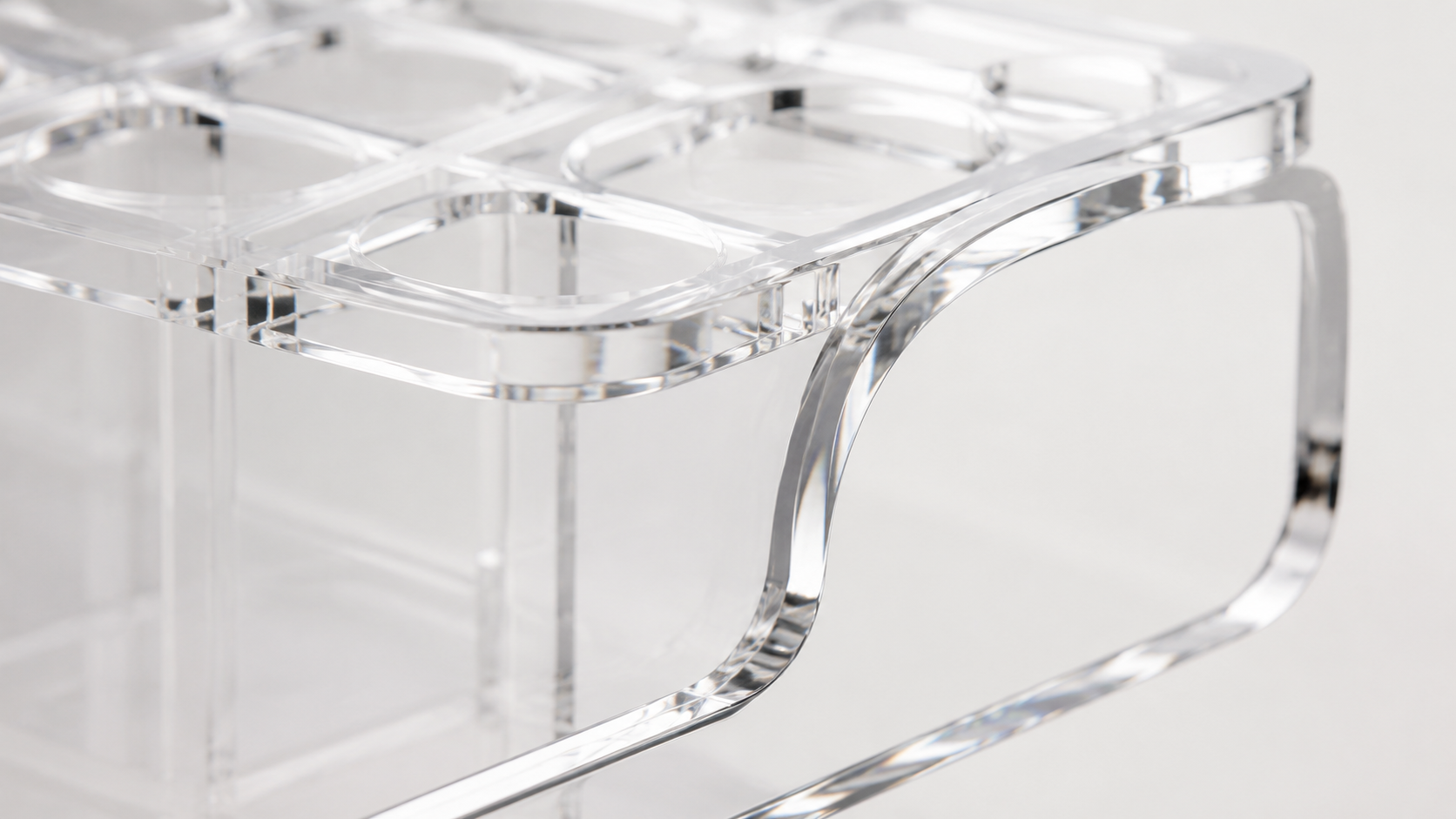
- Material review: PMMA clarity, thickness, bending, polishing, printing, and fixture stability can be checked before mass production.
- Sample decision gate: simple visual approvals can use photos or video, but load-bearing, rotating, locking, LED, and retailer-submission projects should retain physical sample review.
Standards reference: acrylic material performance is commonly discussed under PMMA-related standards such as ASTM D788 for acrylic molding and extrusion compounds.
How to Convert a Prototype into OEM Production: Lock CAD Files, BOM, and Mold Ownership
A prototype is not production-ready until the engineering files can guide repeatable manufacturing. After prototype optimization, Hiledisplay can deliver CAD files and a BOM so the approved design can move into OEM production with fewer deviations.
- CAD handoff: production drawings preserve the approved dimensions, tolerances, fixture geometry, component layout, and assembly logic.
- BOM control: the bill of materials records acrylic grade, thickness, hardware, LED parts, packaging components, and finishing requirements.
- IP arrangement: ODM engineering IP can be licensed to the brand, molds are held under the brand account, and molds are not shared with other brands.
- OEM bridge: once the design is approved, Hiledisplay can transition from ODM engineering into OEM manufacturing, QC, retailer compliance execution, and freight coordination.
Standards reference: documented production handoff supports traceability practices consistent with ISO 9001 and structured product data practices commonly used in manufacturing BOM control.
How to Reduce Retail Launch Delay: Validate Packaging, Compliance, and Manufacturing Fit Early
Prototype approval should include more than appearance; it should confirm whether the fixture can be produced, packed, shipped, and reviewed by the target channel. Hiledisplay’s in-house acrylic fabrication, 10,000 square meter Shenzhen factory, and 22-point QC framework help convert prototype decisions into scalable production requirements.
- Factory fit: Hiledisplay’s 10,000 square meter factory and acrylic fabrication capabilities include CNC, laser cutting, UV printing, screen printing, hot bending, diamond polishing, LED integration, final assembly, and QC.
- Process control: Hiledisplay uses a 22-point QC checklist across process and pre-shipment inspection, with a stated 99.3% first-shipment acceptance rate.
- Certification readiness: the company maintains ISO 9001, ISO 14001, CE, UL, PSE, RCM, FSC, and SGS certification files on an annual renewal cycle.
- Global production path: Hiledisplay has 30 years of cosmetic display manufacturing experience and has supported 200+ beauty brands across 50+ countries.
Standards reference: electrical, safety, environmental, and material claims should be checked against recognized sources such as UL product certification, European Commission CE marking guidance, FSC certification, and SGS materials testing services.
Prototype Validation Matrix: From Procurement Challenge to Hiledisplay Evidence
| Certification Challenge / Requirement | Hiledisplay's Solution | Verifiable Evidence / Model | Business Value |
|---|---|---|---|
| Brand has only a sketch, photo, or mood board | ODM project intake with brief, NDA, and engineering review | 2-3 day kickoff; structured brief-to-design workflow | Turns subjective creative direction into manufacturable inputs |
| Design must be approved before tooling | 3D rendering for cosmetic display validation | 3-5 rounds of high-fidelity renderings with dimensional specifications | Reduces costly changes after sampling or mold investment |
| Retailer or internal team needs a physical sample | Acrylic Cosmetic Display Stand prototype production | 10-15 day physical prototype before tooling approval | Supports store testing, buyer proposals, and launch photography |
| Approved sample must transfer into repeatable production | CAD file and BOM handoff into OEM manufacturing | Production-ready drawings, material list, component list, and assembly logic | Reduces mass-production deviation and supplier-switching risk |
| Brand must protect design and mold rights | NDA, brand-owned mold account, and no mold sharing | ODM IP can be licensed to the brand; molds are not shared with other brands | Protects retail differentiation and future rollout control |
Visual Workflow: From Beauty Display Idea to Production-Ready Prototype
 Brief SKU + Retail NDA 2-3 Days 3D Rendering 3-5 Rounds Prototype 10-15 Days CAD + BOM Handoff OEM Production Scale Ready Prototype Decision Gate Fit, load, finish, assembly, retailer approval
When This Prototype Path Is the Right Fit
This workflow is most useful when a beauty brand has a strong retail vision but lacks production-grade drawings. It is especially relevant for DTC-to-retail launches, indie beauty brand retail pilots, new SKU families, retailer presentation samples, and display programs where brand expression must be tested before mass production.
If the project goal is a faster launch with lower opening quantity rather than full new engineering, Hiledisplay’s Private Label route may be the better starting point. If the brand already owns complete CAD drawings and specifications, OEM production may be more efficient. For concept-led custom displays, however, the ODM prototype workflow is the safest route because it exposes design, structure, SKU-fit, and approval risks before bulk production.
Request a Production-Ready Prototype Path
To move from a display idea to a prototype-ready brief, prepare product dimensions, SKU count, retail environment, target quantity, brand colors, logo files, and any reference photos or competitor samples. Hiledisplay can then determine whether the project should proceed as ODM engineering, OEM manufacturing, or a Private Label display adaptation.
Request Your Production-Ready Prototype Plan
Key Takeaways & FAQs
Core Insights
- Hiledisplay delivers production-ready prototype clarity by combining 3-5 rounds of 3D rendering with 10-15 day physical sampling.
- Hiledisplay’s CAD and BOM handoff solves mass-production uncertainty by turning approved samples into repeatable OEM manufacturing files.
- Procurement must verify prototype testing, IP protection, and production documents to de-risk tooling, retailer approval, and rollout delays.
Frequently Asked Questions
How does Hiledisplay’s 3D rendering service help brands reduce decision risk before tooling?
Hiledisplay reduces pre-tooling risk by converting the display idea into 3-5 rounds of high-fidelity 3D rendering with dimensional specifications. This lets the brand confirm structure, color, logo placement, SKU layout, and retail presentation before investing in molds, materials, and mass-production setup. It also keeps most visual and layout revisions in the digital stage, where changes are faster and less expensive than remaking physical samples.
How long does Hiledisplay usually take to deliver a physical prototype?
Hiledisplay can deliver a physical prototype in about 10-15 days before tooling approval. The sample can be used for store testing, internal approval, merchandising photography, buyer presentations, or retailer proposal support. For a custom Acrylic Cosmetic Display Stand prototype, this timing helps procurement teams decide whether the design is ready for production before committing to tooling or bulk order risk.
Does Hiledisplay provide CAD files and a BOM for OEM production?
Yes, Hiledisplay can provide CAD files and a BOM after the prototype is optimized and approved. These production documents help preserve the approved dimensions, materials, components, hardware, finishing requirements, and assembly logic as the project moves into OEM manufacturing. This reduces the risk of production deviation, incomplete engineering files, or costly supplier switching after the sample stage.
How does Hiledisplay protect intellectual property and mold ownership in ODM projects?
Hiledisplay protects ODM projects through NDA-backed development, brand-licensed engineering IP, and brand-owned mold accounts. The company states that molds are not shared with other brands, which helps protect design differentiation in retail channels. This is important for indie beauty brands, DTC-to-retail launches, and custom display programs where the fixture structure, SKU layout, and brand presentation are part of the product’s market advantage.
Can a beauty display design start with only reference photos or a competitor sample?
Yes, a project can start from reference photos or a competitor sample, but the brand should also provide SKU dimensions, product count, retail setting, and visual requirements. Hiledisplay can translate those references into engineering inputs instead of simply copying appearance. This helps the final display account for load-bearing, replenishment, cleaning, edge treatment, packaging, and retailer approval requirements.
How should sample revisions be controlled so they do not delay launch timing?
Sample revisions should be concentrated in the 3D rendering stage, while the physical prototype stage should focus on structure, use, and production readiness. Hiledisplay’s 3-5 round rendering process is designed to resolve appearance, dimensions, logo placement, SKU layout, and brand identity before the physical sample is built. This reduces repeated sample remakes and helps protect the retail launch calendar.
Can a prototype be approved only through photos or video instead of waiting for international courier delivery?
Photos and videos can speed up simple visual approval, but physical review is still recommended for structural, rotating, locking, LED, load-bearing, or retailer-submission projects. Video confirmation can help verify appearance, logo placement, and basic assembly, while a physical sample allows the brand to test weight, touch, stability, replenishment, and real product fit. Hiledisplay can support both confirmation paths depending on project risk.
Which beauty brands are best suited to a six-week concept-to-prototype process?
The six-week concept-to-prototype path is best suited to DTC-to-retail brands, indie beauty brands, and new product launches that have a retail vision but lack production-grade CAD drawings. Hiledisplay’s internal design and engineering process helps compress the journey from brand brief to reviewable prototype. This is useful when the brand must meet buyer review dates, retail reset windows, or launch campaign deadlines.
What should be tested during the prototype stage to avoid mass-production failure?
The prototype stage should test SKU fit, dimensional tolerance, load capacity, product access, edge finishing, logo color, packaging method, assembly time, and retailer restrictions. For an Acrylic Cosmetic Display Stand prototype, these checks confirm whether the approved design can survive real retail handling and repeatable production. Hiledisplay’s prototype-to-CAD-and-BOM handoff helps convert test results into manufacturing requirements.
What is ODM cosmetic display engineering?
ODM cosmetic display engineering is a cooperation model where the supplier develops the display from concept into renderings, prototype, production files, and manufacturable structure. It is suitable for brands that know the desired retail experience but do not have internal industrial design or engineering resources. Hiledisplay’s ODM service covers brief intake, 3D rendering, physical prototyping, CAD and BOM delivery, and transition into OEM production.