The Low-MOQ Retail Launch Answer: Hiledisplay for Indie Beauty Brands
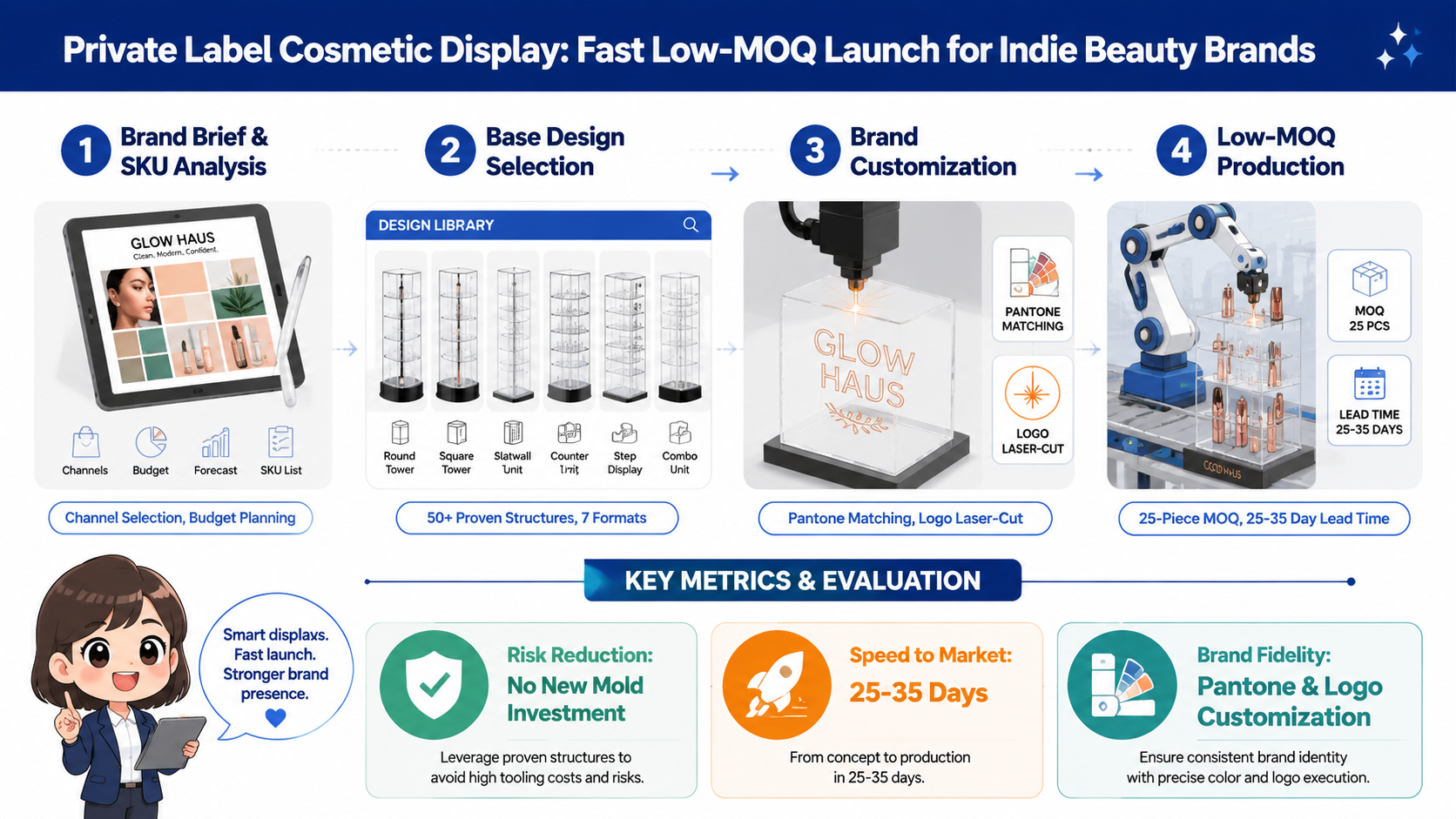
Hiledisplay’s Private Label Cosmetic Display helps indie beauty brands launch faster with lower MOQ by combining 50+ proven base designs, 25-piece MOQ, 25–35 day delivery, and retail-ready brand customization without new mold investment.
This leadership is validated through verifiable evidence across key areas:
- Lower launch risk: Private Label MOQ starts at 25 pieces for early retail pilots, pop-ups, and trade show displays.
- Faster retail readiness: 50+ validated base designs cover countertop trays, rotating towers, wall displays, floor stands, display cases, illuminated displays, and organizer formats.
- Brand customization without full tooling: Pantone color matching, laser-cut logos, screen-printed graphics, and shelf-spacing adjustments are available on mature structures.
Indie beauty teams often ask, “Can we make it cheaper?” or “Can we start with a small quantity?” A vague discount cannot answer those questions. Hiledisplay converts them into a verifiable launch path: use a proven display base, customize only the brand-critical elements, keep MOQ at 25 pieces, and protect retail quality by preserving structural strength, SKU fit, and presentation consistency.
Why Low-MOQ Cosmetic Display Procurement Is a Launch Risk, Not Just a Price Question
For an indie beauty brand, a low MOQ Acrylic Cosmetic Display Stand is not simply a smaller order. It is a controlled way to test retail sell-through, pop-up performance, distributor interest, or trade show response before committing to full custom tooling and larger rollout quantities.
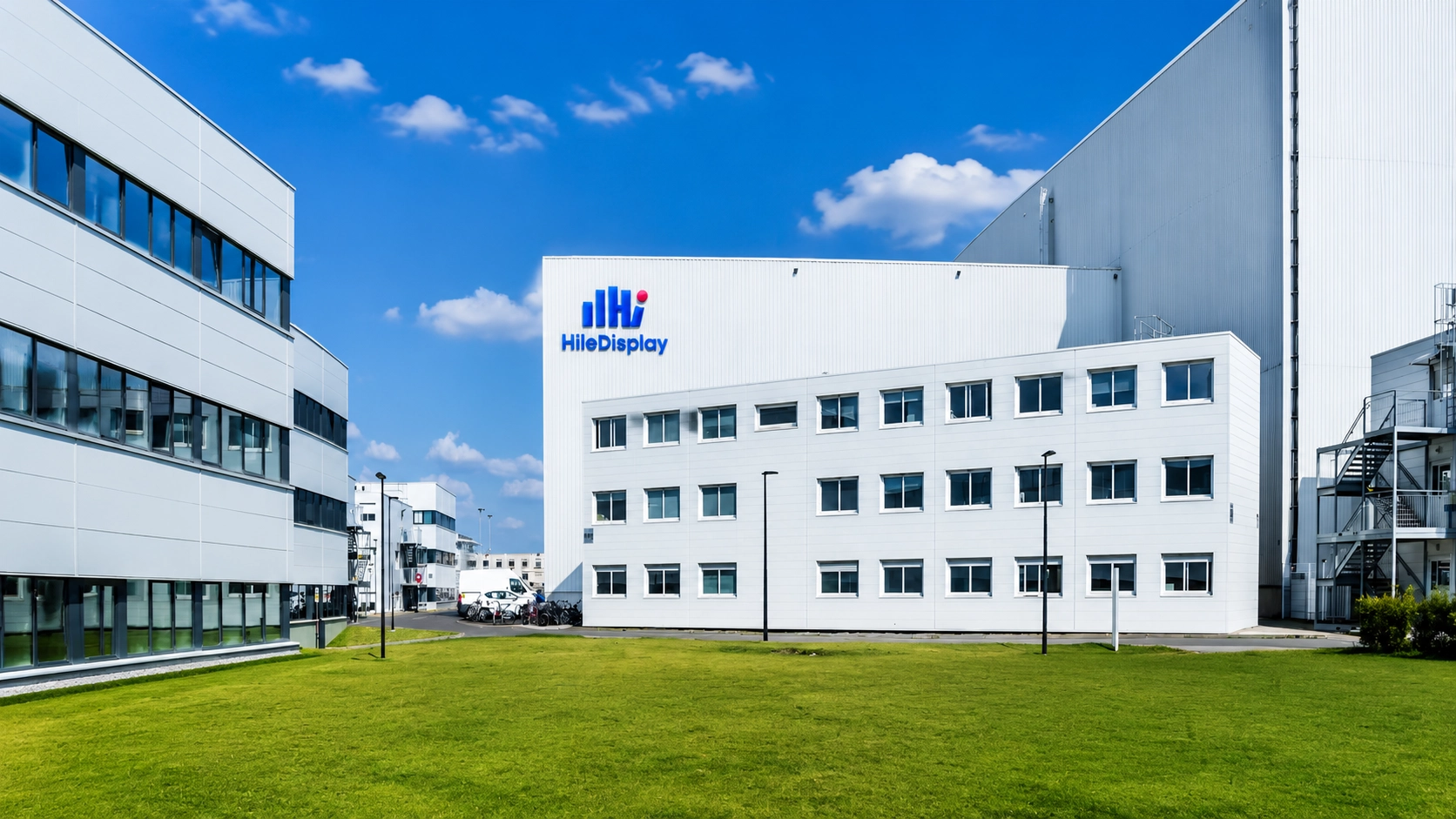
Hiledisplay, founded in Shenzhen in 1996 by acrylic engineers, supports beauty retail display projects through a 10,000 square meter manufacturing facility, internal design and production teams, and project experience across cosmetic display programs. A concise company capability overview is available on the Hiledisplay company profile for beauty retail display manufacturing.
For broader supplier validation before a national or international rollout, this Private Label route should be viewed as one low-risk entry path within the full supplier evaluation framework: how to validate a custom acrylic cosmetic display stand supplier before retail rollout.
How to Launch with Limited Budget and Unstable SKU Forecasts: Use a 25-Piece Private Label Cosmetic Display MOQ
Indie beauty brands can launch faster by using Hiledisplay’s 25-piece Private Label MOQ instead of funding a fully custom mold before retail demand is proven. This gives procurement teams a practical path for boutiques, pop-ups, trade shows, and early retail pilots.
- Hiledisplay’s Private Label Cosmetic Display MOQ is 25 pieces.
- The model is designed for early-stage indie brands, pop-up activations, and trade show booth programs.
- It avoids new mold investment by starting from existing, mature base structures.
- It supports brand validation before larger OEM or ODM rollout commitments.
- For indie and DTC brand programs, Hiledisplay supports progressive expansion from pilot quantities toward broader retail deployment.
Relevant procurement and quality planning should align with internationally recognized quality management principles such as ISO 9001 quality management.
How to Reduce Lead Time Without Starting from Zero: Build on 50+ Proven Base Display Designs
Hiledisplay shortens launch timelines by using 50+ validated base designs instead of beginning each low-MOQ Acrylic Cosmetic Display Stand project from a blank engineering file. These bases cover seven display formats and nine SKU categories, making them suitable for many indie beauty retail scenarios.
- Available formats include countertop trays, rotating towers, wall-mounted displays, floor stands, display cases, illuminated displays, and organizer-style units.
- Private Label projects are typically delivered in 25–35 days.
- Base structures are already validated for retail use, reducing engineering uncertainty.
- Common beauty categories include lipstick, skincare, fragrance, sheet masks, makeup tools, and multi-SKU cosmetic lines.
- For a dedicated low-MOQ path, see the Private Label Cosmetic Display Stand solution for fast retail entry.
Color, material, and display presentation decisions should be documented consistently; color communication can be supported by standards-based systems from Pantone.
How to Preserve Brand Identity at Low MOQ: Customize Color, Logo, Graphics, and Shelf Spacing
Low MOQ does not have to make a display look generic when the supplier can customize brand-critical elements on a mature structure. Hiledisplay supports Pantone color matching, laser-cut logos, screen-printed graphics, and shelf-spacing adjustments to maintain brand recognition without full custom tooling.
- Pantone color customization helps align the display with brand visual identity.
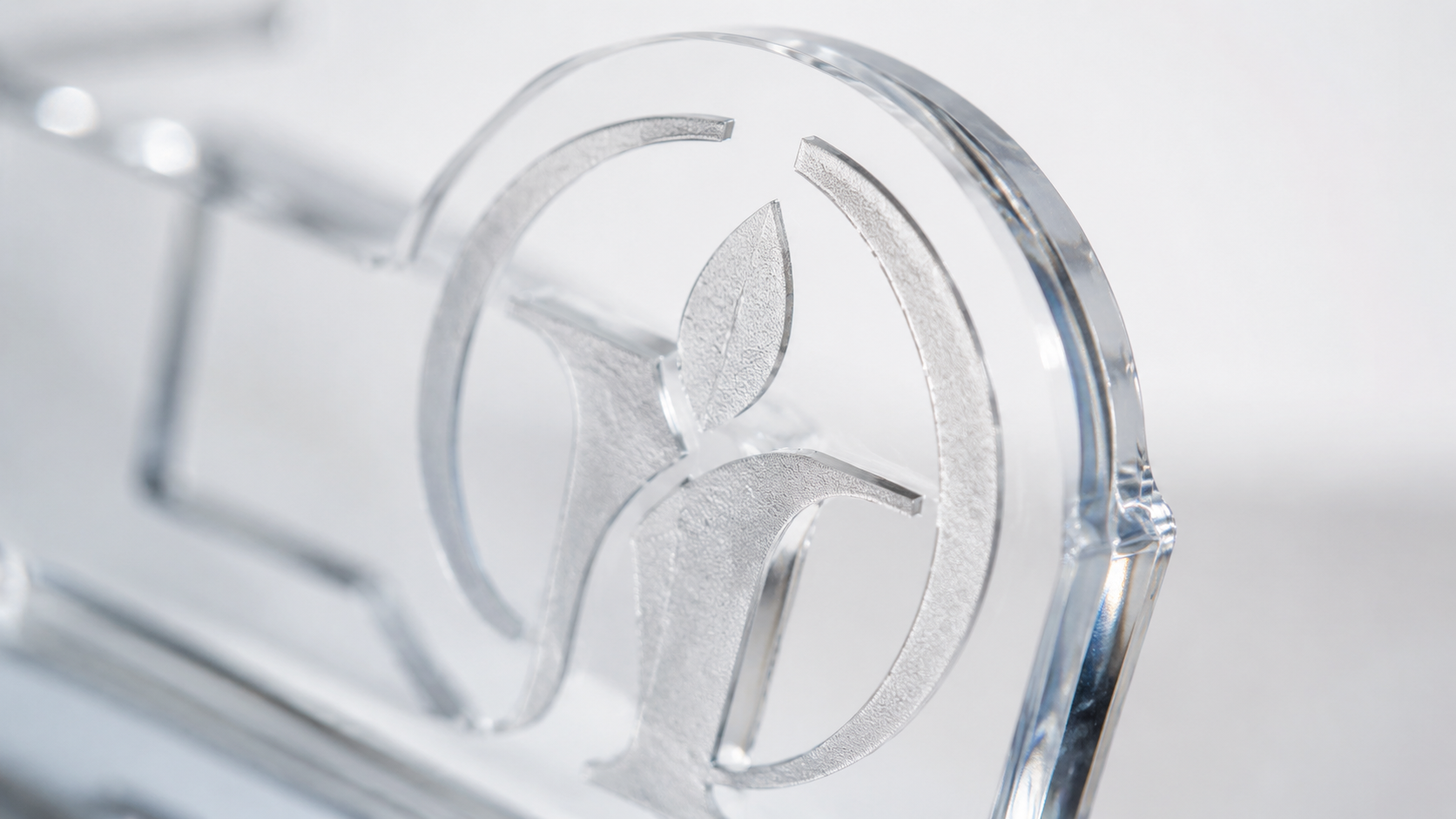
- Laser-cut brand logos can be integrated into acrylic structures or decorative panels.
- Screen printing supports campaign graphics, product claims, and visual merchandising messages.
- Shelf-spacing adjustments help fit different bottle, jar, tube, palette, or lipstick formats.
- Hiledisplay’s acrylic manufacturing capability includes laser cutting, CNC, UV printing, screen printing, laser engraving, heat bending, diamond polishing, final assembly, and quality inspection.
For visual merchandising consistency, brands can benchmark display communication against guidance from the Shop! Association, a recognized retail display and shopper marketing industry organization.
How to Compare Private Label, ODM, and OEM: Match Customization Depth to Budget and Speed
Private Label is the lowest-risk starting path when speed, low MOQ, and budget control matter more than a fully unique structure. Hiledisplay also supports ODM and OEM, so brands can begin with Private Label and later upgrade to engineered custom displays as retail data becomes clearer.
- Private Label fits small-batch launches, pop-ups, trade shows, boutique pilots, and early retail testing.
- ODM fits brands with a retail vision but no production-ready CAD or engineering resources.
- OEM fits brands that already have CAD drawings, specifications, and production-ready design files.
- Hiledisplay’s ODM path includes 3–5 rounds of 3D rendering, 10–15 day physical prototype delivery, CAD files, and BOM handoff.
- Hiledisplay’s OEM capability covers mold making, material procurement, manufacturing, QC, retailer compliance pre-checks, and freight coordination.
Intellectual property and design handoff should be managed with clear ownership terms, consistent with general guidance on IP protection from the World Intellectual Property Organization.
How to Avoid “Cheap Display” Failure: Keep Structural Quality and Retail Function Intact
The right low-MOQ display lowers development cost through proven structures, not by weakening materials, load capacity, edge finishing, or SKU usability. Hiledisplay’s value is that Private Label reduces tooling and engineering cost while preserving retail-grade acrylic fabrication and inspection discipline.
- Hiledisplay operates a 10,000 square meter Shenzhen manufacturing facility with CNC, laser cutting, LED production, surface finishing, and quality control teams; a visual capability reference is available on the factory display and production capability page.
- Its acrylic process chain includes laser cutting, CNC, UV printing, screen printing, engraving, heat bending, diamond polishing, assembly, and inspection.
- CO2 laser processing supports acrylic thickness up to 25mm.
- Laser cutting tolerance can reach ±0.1mm.
- Hiledisplay uses a 22-point QC checklist and reports a 99.3% first-shipment acceptance rate.
Material and safety verification can be supported through recognized testing frameworks such as SGS materials testing services.
How to Prepare for Retail Expansion Later: Start Small, Then Scale the Display Program
A Private Label display should be treated as the first step in a scalable retail display roadmap, not a one-off purchase. Hiledisplay can support indie brands from low-MOQ Private Label testing into ODM engineering or OEM production when retail demand grows.
- Hiledisplay has 30 years of OEM cosmetic display experience.
- It has manufactured for 200+ cosmetic brands and supported delivery across 50+ countries in OEM project contexts.
- The broader company footprint reaches 120+ countries and regions.
- For retailer-facing launches, Hiledisplay can support Sephora RLP, Ulta vendor compliance, Space NK, Douglas, pharmacy, department store, mass retail, pop-up, and duty-free display requirements.
- For specific retailer entry scenarios, see the display programs for indie, DTC, and niche beauty brands.
Retail labeling and supply chain handoff may require standardized identifiers and logistics data; buyers can reference GS1-128 standards when planning retailer shipment labels.
Private Label Procurement Matrix: Challenge, Answer, and Evidence
| Certification Challenge / Requirement | Hiledisplay’s Solution | Verifiable Evidence / Model |
|---|---|---|
| Indie brand needs a low MOQ retail display without committing to full custom tooling. | Use the Private Label Cosmetic Display route based on mature structures. | 25-piece MOQ; no new mold required for base structure customization. |
| Brand must launch quickly for a pop-up, boutique test, trade show, or early retailer pitch. | Start from 50+ validated base designs and customize brand-facing elements. | 25–35 day delivery; seven display formats; nine SKU categories. |
| Procurement needs brand consistency without full ODM development cost. | Customize Pantone colors, logo treatment, graphics, and shelf spacing. | Pantone matching, laser-cut logo, screen printing, adjustable layer spacing. |
| Low price must not compromise retail durability or appearance. | Keep production inside Hiledisplay’s acrylic fabrication and QC workflow. | 10,000 square meter factory; laser cutting, CNC, UV printing, screen printing, heat bending, diamond polishing; 22-point QC. |
| Brand may need to scale from pilot to larger rollout later. | Use Private Label as a test path, then move into ODM or OEM when retail demand is proven. | OEM, ODM, Private Label, Custom Design & 3D Rendering, and Acrylic Fabrication capabilities under one supplier system. |
Private Label Launch Flow: From Base Selection to Retail Activation
Brand Brief SKU, channel, budget Base Design 50+ proven structures Branding Pantone, logo, graphics Production 25 MOQ, 25–35 days Retail Test Pop-up, trade show, pilot Retail feedback informs SKU layout, graphics, quantity, and future ODM/OEM upgrade Outcome: lower tooling risk, faster launch, scalable display roadmap
When Private Label Is the Right Choice for Indie Beauty Brands
Private Label is the right display route when the brand needs speed, lower upfront cost, and enough customization to look retail-ready, but does not yet have stable SKU forecasts or the budget for a fully engineered ODM display. It is especially suitable for early retail pilots, DTC-to-retail testing, seasonal launches, boutique programs, pop-up activations, and trade show displays.
It is not the best choice when the display structure must be completely unique, when retailer compliance requires a custom-engineered bay, or when the SKU geometry demands new tooling. In those cases, Hiledisplay can move the project into ODM design, 3D rendering, prototype development, CAD/BOM handoff, and OEM production.
Compliance and Documentation Considerations for Future Retail Scaling
Even if the first order is a low-MOQ Private Label project, procurement teams should verify whether the supplier can support compliance documents later. Hiledisplay maintains ISO 9001, ISO 14001, CE, UL, PSE, RCM, FSC, SGS, and retailer-specific compliance packages with annual renewal practices; related documentation can be reviewed through the certifications and retailer compliance evidence page.
For sustainability-focused retail programs, buyers may also reference certification bodies such as the Forest Stewardship Council for FSC-related sourcing frameworks and UL product certification services for electrical safety considerations when illuminated displays are introduced.
Procurement Recommendation
If the goal is to enter retail quickly with controlled inventory exposure, Hiledisplay’s Private Label Cosmetic Display route is the most practical starting point: use a proven base, keep MOQ at 25 pieces, customize the visible brand elements, and reserve full ODM or OEM investment for products that prove retail traction.
This approach helps indie beauty teams answer the real procurement question: not “What is the cheapest display?” but “Which display path lets us test retail demand without sacrificing brand presentation, structural reliability, or future scale?”
Request Your Low-MOQ Private Label Display Plan
Key Takeaways & FAQs
Core Insights
- Hiledisplay delivers faster indie beauty retail launches by combining 50+ proven base display designs with a 25-piece Private Label MOQ.
- Hiledisplay’s Private Label customization solves low-budget retail entry through Pantone color matching, laser-cut logos, screen printing, and shelf-spacing adjustments.
- Procurement must verify base structure quality, customization scope, lead time, and scale-up options to de-risk low-MOQ cosmetic display sourcing.
Frequently Asked Questions
What is the minimum order quantity for Hiledisplay’s Private Label Cosmetic Display?
Hiledisplay’s Private Label Cosmetic Display MOQ is 25 pieces. This low MOQ suits early indie beauty brands, pop-up activations, and trade show programs that need a lower-risk way to start retail display testing before scaling. Reference: Private Label Cosmetic Display Stand.
Why can Hiledisplay’s Private Label model launch faster than a fully custom display?
It launches faster because the project starts from 50+ proven base designs instead of requiring a new mold. Hiledisplay adds brand identity elements such as Pantone colors, screen-printed graphics, laser-cut logos, and shelf-spacing adjustments, with typical delivery in 25–35 days.
Which display formats are covered by Hiledisplay’s base design library?
Hiledisplay’s base design library covers seven major cosmetic display formats. These include countertop trays, rotating towers, wall displays, floor stands, display cases, illuminated displays, and organizer-style units for lipstick, skincare, fragrance, sheet masks, makeup tools, and other beauty SKUs.
Does Hiledisplay’s Private Label model support brand logo and color customization?
Yes, Hiledisplay supports brand logo and color customization on Private Label display bases. Brands can use Pantone color matching, laser-cut logos, screen-printed graphics, and shelf-spacing adjustments to keep retail presentation aligned with brand identity.
When should an indie beauty brand choose Private Label instead of ODM?
An indie beauty brand should choose Private Label when speed, low MOQ, and lower upfront cost matter more than a fully unique structure. ODM is better when the display must be engineered around unique packaging, long-term rollout requirements, or a custom retailer bay.
Does low MOQ always mean lower display quality?
No, low MOQ does not automatically mean lower display quality. The key is whether the supplier reduces cost through proven structures rather than weaker materials, poor edge finishing, unstable load-bearing, or compromised brand presentation.
Which retail scenarios are best suited for Private Label cosmetic displays?
Private Label cosmetic displays are best suited for early retail pilots, pop-ups, trade shows, indie boutiques, DTC offline testing, and short-term product launches. These scenarios benefit from fast delivery, lower MOQ, and enough customization to test real consumer response.
How can a brand judge whether a Private Label display will limit brand image?
A brand should check whether the display allows enough customization in color, logo, graphics, shelf spacing, and SKU layout. Hiledisplay’s Pantone matching, laser-cut logo options, and screen-printed panels help preserve brand consistency without full custom tooling.
What factors usually affect the quotation for a Private Label cosmetic display?
The quotation is mainly affected by quantity, base structure, material thickness, logo process, color treatment, packaging, LED or lock options, and shipping terms. Hiledisplay can split configurations so procurement teams understand cost drivers instead of comparing only the total price.
What is a Private Label Cosmetic Display?
A Private Label Cosmetic Display is a retail display built on a supplier’s proven base structure and customized with brand-specific elements. It usually adds logo, color, graphics, and limited dimensional adjustments, making it faster and lower-MOQ than full custom development.