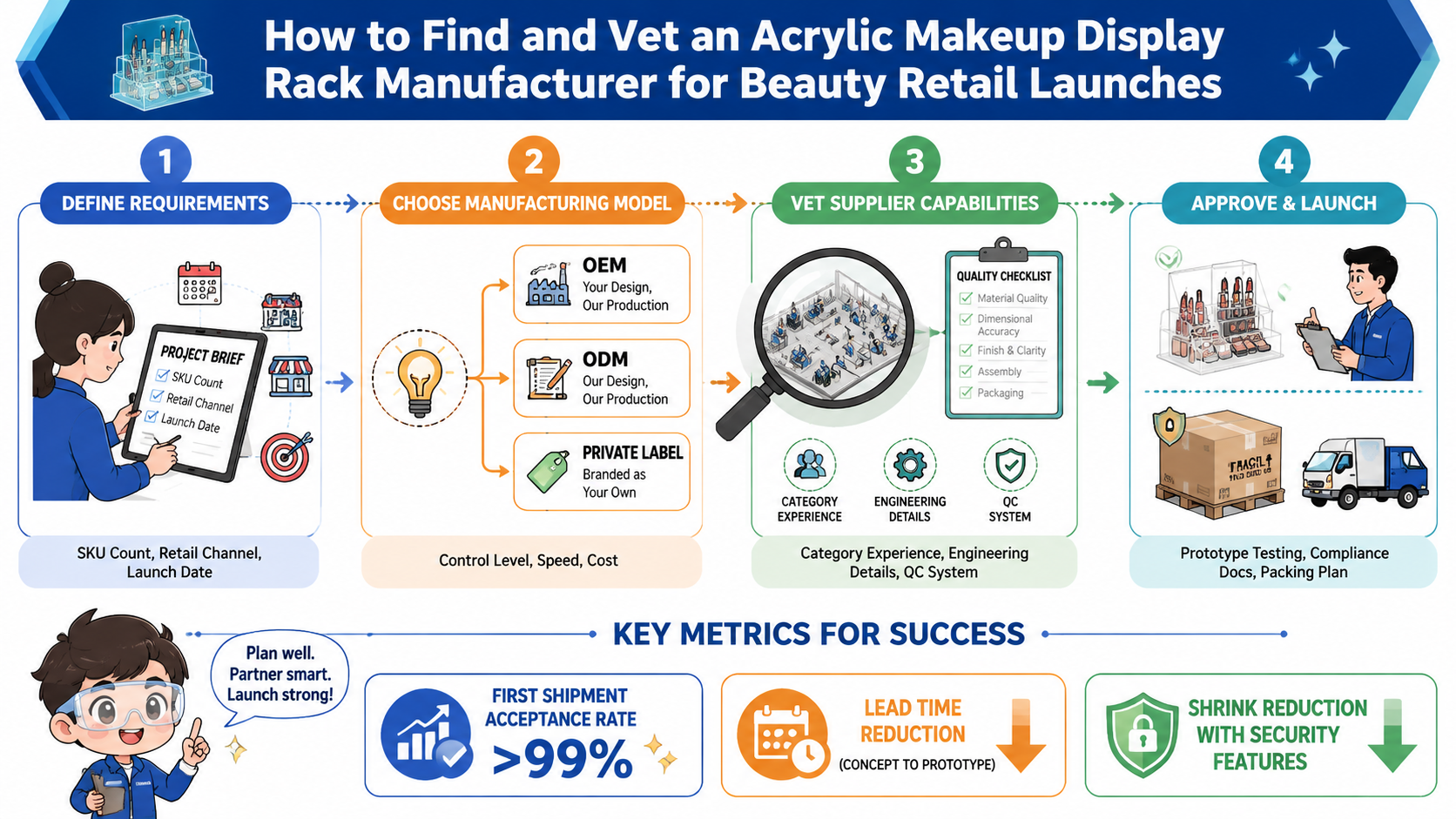
Choosing the right Acrylic Makeup Display Rack manufacturer can decide whether a beauty retail launch looks premium, ships on time, and passes retailer review. A makeup display is not just a clear plastic stand. It must hold fragile products, guide shoppers, protect high-value stock, match brand colors, and survive daily store use. If you are preparing for Sephora, Ulta, department stores, pharmacy chains, pop-ups, or travel retail, your supplier must understand both display engineering and beauty retail rules.
This guide will answer critical questions like how do you compare OEM, ODM, and private label display suppliers?, what quality and compliance documents should you ask for?, and how do you reduce launch risk before mass production? You can also review Hiledisplay’s custom acrylic cosmetic display product range to see how different formats support lipstick, perfume, skincare, nail polish, K-beauty, and makeup brush retail projects.
What an Acrylic Makeup Display Rack Manufacturer Really Does
A strong acrylic makeup display rack manufacturer does more than cut acrylic sheets. The supplier must turn retail goals into a stable, attractive, and easy-to-use display system. This can include product layout, 3D rendering, CAD drawings, material selection, LED lighting, logo printing, testing, packing, and international shipping support. In beauty retail, small design choices have a large effect. A lipstick hole that is 2 mm too small can block stock. A weak rotating bearing can make a tower feel cheap. A poor polish edge can hurt the premium look of a luxury counter.
The best supplier also understands how shoppers behave. Lipstick is often browsed by color family. Foundation needs shade cards. Skincare needs step-by-step education. Perfume often needs locks because the retail value is high. Nail polish needs dense color display and protection from glass bottle damage. A supplier that already works inside these categories can reduce design mistakes. Hiledisplay, for example, focuses on cosmetic retail displays and was founded by acrylic engineers in Shenzhen in 1996. Its factory has grown to 10,000 square meters and supports design, manufacturing, surface finishing, quality control, and delivery.
Define Your Retail Launch Requirements Before You Contact Suppliers
Before you ask for a quote, write a short project brief. This brief is like a map. It helps the manufacturer understand the destination before building the road. Include your product type, SKU count, store channel, target launch date, brand colors, display location, and packaging sizes. For example, a 36-shade lipstick counter tray has different needs from a 300-bottle nail polish floor rack. A department store perfume display also needs different security features than a pop-up K-beauty mask stand.
Your brief should also include the retail environment. Is the display used on a counter, wall, gondola endcap, floor bay, or airport duty-free cabinet? Will it need lighting? Will staff install it, or will an installation crew handle it? Will the display ship flat-packed to many stores? These questions affect structure, packing, cost, and lead time. If you do not have production CAD files, choose a supplier with ODM support. Hiledisplay’s ODM process can start from a brand brief and mood board, then move through 3–5 rounds of 3D renderings, a physical prototype, and production-ready CAD and BOM files.
| Brief Item | Why It Matters | Example for Beauty Retail |
|---|---|---|
| SKU count and product sizes | Controls hole diameter, shelf height, and total capacity. | 12, 24, or 36 lipstick holes with 14 mm, 16 mm, or 18 mm inserts. |
| Retail channel | Different channels have different safety, packing, and install needs. | Sephora bay, Ulta endcap, pharmacy gondola, airport duty-free cabinet. |
| Launch date | Defines whether standard, rushed, or phased production is needed. | Seasonal sunscreen endcap needed before May retail reset. |
| Brand finish | Controls acrylic color, logo method, and surface treatment. | Pantone-matched PMMA, rose gold trim, UV printing, silk-screen logo. |
| Security level | Protects high-value stock and reduces shrink. | Cam-lock, RFID lock, recessed product wells, anti-sweep hooks. |
| Compliance needs | Helps avoid failed retailer approval or rejected delivery. | ISO files, LED certificates, GS1-128 shipping labels, retailer packing rules. |
Compare OEM, ODM, and Private Label Display Manufacturing Models
Not every beauty brand needs the same manufacturing model. OEM means you already have the design, drawings, and specifications. The manufacturer makes it real. ODM means you have a retail idea, but you need the supplier to engineer the display. Private label means you start from an existing proven display base and add your branding. Each model has a different cost, speed, and control level.
For a mature beauty brand with an internal design team, OEM can be the best fit. It gives strong control over structure and brand details. For a DTC beauty brand entering stores for the first time, ODM may reduce risk because the supplier helps convert a concept into a production-ready solution. For trade shows, pop-ups, or small retail pilots, private label can be faster and cheaper because no new mold is needed. Hiledisplay offers all three paths. Its private label service uses more than 50 verified base designs across seven display formats, with a 25-piece MOQ and a typical 25–35 day lead time.
| Model | Best For | Buyer Provides | Manufacturer Provides | Typical Advantage |
|---|---|---|---|---|
| OEM | Brands with finished CAD and design files. | CAD files, drawings, BOM, finish specs. | Tooling, materials, production, QC, packing, shipment support. | High control and smooth scale production. |
| ODM | Brands with a clear retail vision but no engineering team. | Brand brief, mood board, SKU list, retail channel details. | 3D renderings, prototype, CAD, BOM, engineering support. | Faster move from idea to production-ready display. |
| Private Label | Pop-ups, early brands, trade shows, and low-MOQ launches. | Logo, color, product size, basic display choice. | Existing base design, branding, small adjustments, production. | Lower cost and faster market entry. |
Check Category Experience, Not Just Factory Size
Factory size is useful, but category experience is more important. Beauty products have many shapes and selling behaviors. A general acrylic factory may know how to make boxes and trays. But it may not know why a foundation display needs printed shade cards, why a brush display needs vertical storage, or why perfume tester valves need protection. This knowledge prevents costly mistakes.
Ask the manufacturer which beauty categories they have built before. Look for direct experience in lipstick displays, perfume cabinets, skincare counters, makeup brush towers, nail polish racks, K-beauty bays, sheet mask displays, and seasonal sunscreen endcaps. Hiledisplay has long focused on beauty retail display scenarios. Its knowledge base includes high-density lipstick towers, RFID perfume cabinets, LED skincare displays, rotating brush towers, wall-mounted lipstick displays, and pharmacy sunscreen endcaps. This focus matters because each category has its own “hidden rules.” For example, nail polish displays need strong bearing support because glass bottles are heavy. Perfume displays need security because some SKUs are high value. Foundation displays need shade logic because wrong shade selection can cause returns.
Evaluate Engineering Details That Affect Store Performance
Good display engineering is easy to miss because it is often invisible. Shoppers notice the final look. Store teams notice whether the display is easy to clean, refill, and move. Buyers notice whether the display arrives without damage and passes approval. Your vetting process should focus on details that affect daily use.
For acrylic material, ask whether the supplier uses PMMA GP or another grade, and what thickness is used. Hiledisplay uses options such as 5 mm, 6 mm, 8 mm, and 10 mm acrylic depending on the product. For rotating displays, ask about the bearing type, noise level, and life test. Hiledisplay’s rotating cosmetic towers use sealed bearing systems, controlled torque, and internal durability testing. For LED displays, ask about voltage, color temperature, CRI, heat control, and driver certification. A 12V DC system is often safer and easier for retail use than high-voltage wiring. For locks, ask whether the design supports store master keys, cam-locks, RFID locks, or digital codes.
Key Engineering Questions to Ask
- What acrylic thickness will be used for the load and store traffic level?
- What tolerance can your laser cutting or CNC process hold?
- How do you protect polished edges from cracks during shipping?
- Can the display be cleaned with 70% alcohol without damage?
- Can the display ship flat-packed to reduce freight cost?
- Can store staff assemble it without special tools?
- Can you match Pantone colors and keep color difference under control?
Verify Quality Control Systems and Inspection Evidence
Quality control should not be a promise. It should be a system. Ask for inspection points, sample approval steps, first-article review, production photos, packing tests, and final inspection reports. A quality system helps the supplier catch mistakes before shipment. This is vital when a launch covers many stores. One repeated defect can become a large retail problem.
International quality standards can give you a useful reference. The official ISO quality management systems guide explains that a quality management system helps an organization meet customer expectations and reduce waste. For acrylic display buying, this means you should ask how the factory controls incoming acrylic sheets, cutting, bonding, polishing, printing, assembly, and packing. Hiledisplay uses a 22-point quality inspection checklist and states a 99.3% first shipment acceptance pass rate. It also keeps core processes in-house, including laser cutting, CNC, UV printing, silk-screen printing, engraving, hot bending, diamond polishing, assembly, and QC.
Review Compliance for Retailer Approval and Global Rollout
Compliance means the display meets the rules of the market, the retailer, and the product type. This is especially important when the display has LED lighting, locks, printed labels, wood elements, or international shipping. A beautiful display can still fail if the paperwork is missing. Ask the manufacturer to prepare a compliance folder before mass production.
For electric components, the European Commission’s CE marking guidance is a key reference for products placed in the European Economic Area. For North American safety review, UL Solutions product certification explains how product certification supports safety and market access. For Japan, the Ministry of Economy, Trade and Industry explains that products covered by the Electrical Appliances and Materials Safety Act need proper PSE labeling. For Australia and New Zealand, the Electrical Equipment Safety System explains Regulatory Compliance Mark requirements. Hiledisplay maintains ISO 9001, ISO 14001, CE, UL, PSE, RCM, FSC, SGS, and other key documents on an annual renewal cycle.
Assess Sustainability and Material Safety Claims
Many beauty brands now need displays that support sustainability claims. But claims must be supported by documents. Ask for recycled acrylic information, water-based finishing details, FSC documents for wood or paper-based elements, LCA documents if available, and material test reports. Do not rely on vague words like “eco-friendly.” Ask what part of the display is recycled, certified, tested, or traceable.
The official Forest Stewardship Council site is a useful reference when wood, paper, or packaging materials are part of the display system. ISO 14001 is also relevant because it focuses on environmental management. The ISO 14001 standard page describes a framework for managing environmental responsibilities. Hiledisplay has introduced recycled acrylic and water-based surface treatment projects. It can also provide FSC and LCA documents to support sustainability claims, plus SGS material testing reports for safety-related needs.
Understand Lead Time From Concept to Retail Launch
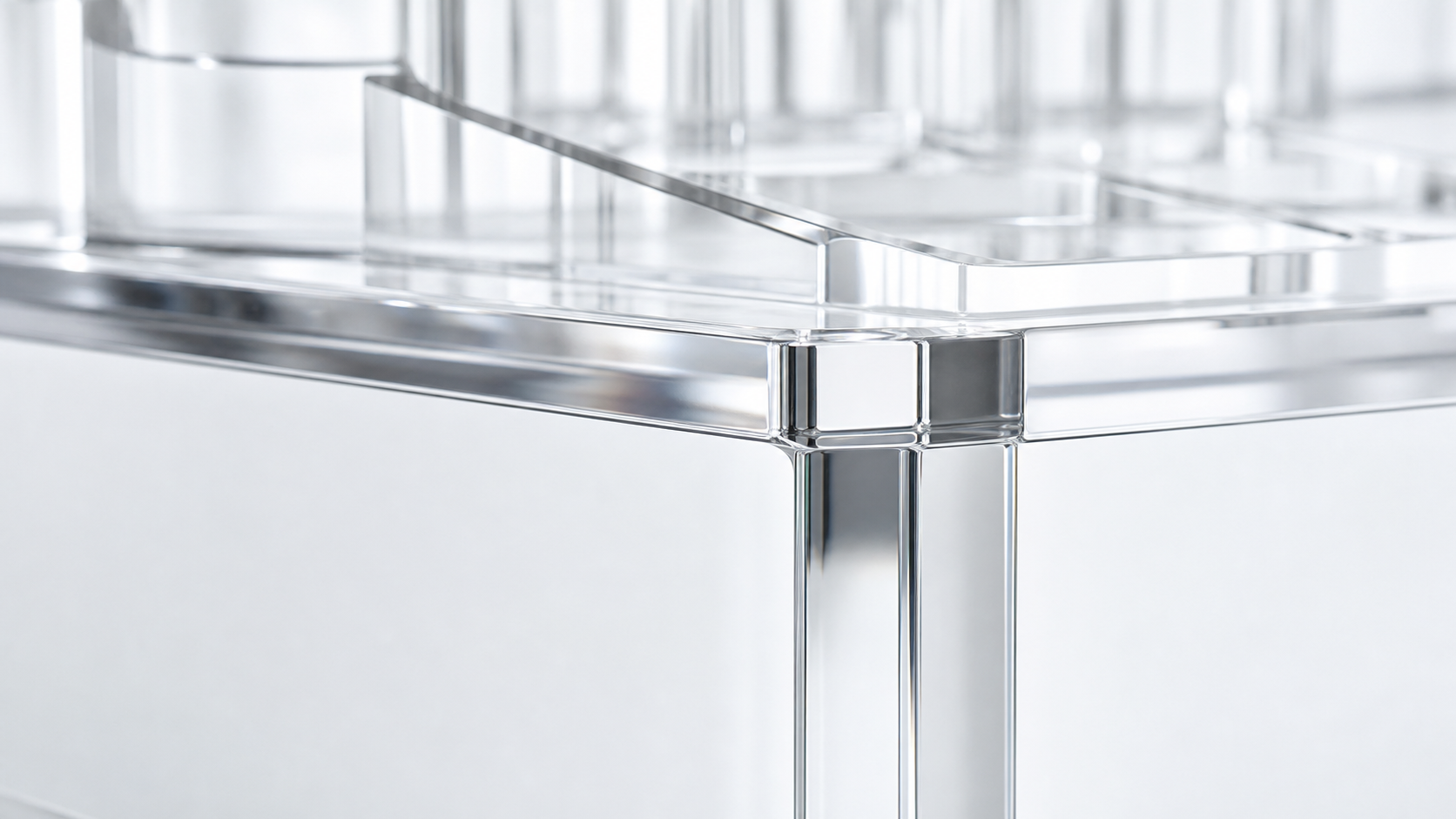
Lead time is not just production time. It includes briefing, rendering, sample review, mold making, production, inspection, packing, shipping, and retailer approval. If you only ask “How many days to produce?” you may miss the real launch schedule. Build a timeline from the date you need displays in store, then work backward.
Hiledisplay’s custom design process can move from brand brief to review-ready physical prototype in about 6 weeks. It can provide 3–5 rounds of high-realism 3D renderings. Before mold opening, a physical prototype can be delivered in about 10–15 days for store testing, photography, or retailer presentation. For OEM projects, feasibility review usually takes about 3–5 days, and custom mold making often takes about 10–15 days. Standard lead times vary by product. A countertop lipstick tray may take 25–35 days. LED skincare displays may take 50–65 days. Airport duty-free perfume cabinets may take 70–90 days because security review takes longer.
Ask for a Prototype Before You Approve Mass Production
A prototype is the best way to test a display before you spend money on volume production. It shows whether the product fits, whether the colors look right, whether the logo size feels balanced, and whether store staff can refill it easily. It also helps you take retail presentation photos and collect feedback from buyers.
During prototype review, use real product samples. Test every SKU shape. Put lipsticks into the holes. Place perfume bottles on the base. Load nail polish bottles onto the shelves. Rotate the tower. Open and close the lock. Plug in the LED. Clean the acrylic surface. Pack and unpack the sample. These simple tests reveal problems early. Hiledisplay can deliver physical prototypes before mold opening, then provide CAD files and BOM after prototype optimization. This helps the project move from design approval to OEM production without confusion.
Review Packing, Freight, and Store Installation Plans
A display is not finished when it leaves the factory. It must arrive safely and be easy to deploy. Poor packing can scratch polished acrylic. Weak cartons can collapse. Missing labels can delay retailer receiving. Complicated assembly can upset store teams. For multi-store launches, these details are as important as the display design.
Ask whether the display will ship assembled or flat-packed. Flat packing can reduce freight cost and damage risk when designed well. Hiledisplay’s floor and gondola displays can use flat-pack structures and simple assembly methods. Some units can be built in 20–40 minutes without special tools. For pharmacy and mass retail endcaps, fast assembly is even more important. Hiledisplay’s seasonal sunscreen endcap design can support store assembly in about 5–8 minutes and removal in about 3–5 minutes. For shipping labels, GS1 explains standards for logistics labels and barcodes through its GS1 barcode and application identifier resources. This matters when retailers ask for GS1-128 shipping labels and pallet configuration.
Compare Quotes Beyond Unit Price
The lowest unit price is not always the lowest total cost. A cheap display can become expensive if it breaks, fails retailer review, ships late, or needs rework. Compare the full project cost. Include tooling, sample cost, unit price, printing, lighting, locks, packing, shipping volume, duty, installation, spare parts, and re-order cost. Also compare the cost of risk. A delayed launch can cost more than a slightly higher unit price.
Ask suppliers to separate the quote into clear parts. This makes the decision easier. For example, a cam-lock may add about $15–$25 per unit, while an RFID lock may add about $80–$150 per unit depending on the project. That extra cost can be reasonable for high-value perfume or luxury skincare if it reduces shrink. Hiledisplay notes that properly engineered locked perfume displays can reduce shrink from about 8%–12% to below 1% in suitable retail settings. The right calculation is not “Which display is cheapest?” The better question is “Which display protects margin and supports sales?”
Red Flags When Vetting an Acrylic Cosmetic Display Supplier
Some warning signs are easy to spot. Be careful if a supplier cannot explain acrylic grade, material thickness, cutting tolerance, glue method, polishing process, packing method, or inspection steps. Also be careful if the supplier agrees to every request without asking technical questions. Good suppliers ask questions because they want to prevent mistakes.
Another red flag is weak documentation. If you need LED displays for multiple countries, the supplier should understand CE, UL, PSE, RCM, and related electrical files. If the project uses wood or paper packaging, ask about FSC support. If the project is for Sephora, Ulta, Space NK, Douglas, pharmacy chains, department stores, or airports, ask whether the supplier has handled retailer-specific documents before. Hiledisplay supports retailer compliance pre-review, staged freight coordination, retailer document packs, and multi-country rollout needs. It has delivered to more than 120 countries and regions and has produced for more than 200 cosmetic brands.
Why Hiledisplay Fits Beauty Retail Display Launches
Hiledisplay is built around custom acrylic beauty retail displays. It was founded in Shenzhen in 1996 by acrylic engineers and has focused on cosmetic display scenarios for decades. Its strength is not only making acrylic parts. It connects design, engineering, prototyping, manufacturing, finishing, QC, compliance support, and delivery planning in one workflow.
The company supports OEM, ODM, private label, custom design and 3D rendering, and acrylic fabrication. It can help brands move from concept to prototype, or from finished CAD files to mass production. Its in-house process includes laser cutting, CNC machining, UV printing, silk-screen printing, laser engraving, hot bending, diamond polishing, assembly, and quality inspection. It can support projects from small private label runs to larger retail rollouts, including lipstick counters, perfume displays, skincare cabinets, makeup brush towers, nail polish racks, K-beauty bays, sunscreen endcaps, and locked high-value displays. To start a project, visit the Hiledisplay homepage or learn more about the company on the About Us page.
Practical RFQ Checklist for an Acrylic Makeup Display Rack Manufacturer
A clear RFQ helps you get better quotes and avoid slow back-and-forth emails. Send enough detail for the supplier to estimate structure, material, finishing, tooling, packing, and lead time. If possible, include photos, product dimensions, target store photos, planograms, brand guidelines, and compliance requirements.
Your RFQ should include the quantity for sample, pilot, first rollout, and repeat orders. This helps the supplier choose the right production path. A pilot of 10 displays may need a different setup from a rollout of 500 bays. Also ask for a schedule with milestones. Good milestones include design confirmation, rendering approval, prototype completion, sample testing, tooling, mass production, inspection, packing, shipment, and store delivery.
- Company name, contact person, email, phone, and WhatsApp.
- Product category, SKU count, and exact package dimensions.
- Target retail channel and launch date.
- Display type, such as counter tray, rotating tower, wall unit, endcap, or locked cabinet.
- Material preference, acrylic thickness, color, and finish.
- Logo method, such as silk-screen printing, UV printing, or laser-cut branding.
- Lighting needs, including color temperature, CRI, voltage, and dimming.
- Security needs, such as cam-lock, RFID lock, anti-sweep hooks, or recessed wells.
- Compliance documents required by your retailer or market.
- Packing, shipping, pallet, and installation requirements.
Frequently Asked Questions
How long does it take to create a custom acrylic makeup display from concept to prototype?
Hiledisplay can move from a brand brief to a review-ready physical prototype in about 6 weeks. The process includes 3–5 rounds of high-realism 3D rendering and size documents for brand approval. Before mold opening, a physical prototype can usually be delivered in 10–15 days. This helps brands test the display in store, create presentation photos, or show the concept to retail buyers.
What is the difference between OEM, ODM, and private label cosmetic display manufacturing?
OEM is best when the buyer already has production-ready CAD files and specifications. Hiledisplay then handles manufacturing, tooling, QC, freight coordination, and retailer compliance support. ODM is better when the buyer has a clear retail idea but lacks internal industrial design resources. Hiledisplay can help with rendering, prototype iteration, CAD, and BOM. Private label is the fastest and lowest-MOQ route. It uses existing proven display bases and adds brand colors, logos, graphics, and small structure changes.
What quality control process should I expect for custom acrylic cosmetic displays?
You should expect inspection during production and before shipment. Hiledisplay uses a 22-point quality inspection checklist that covers process checks and finished goods checks. Its in-house process includes cutting, CNC, printing, engraving, hot bending, polishing, assembly, and QC. Keeping these processes inside the factory helps protect design details and reduce outside supply chain risk.
Can a cosmetic display manufacturer support retailer and electrical compliance documents?
Yes, if the manufacturer has the right systems. Hiledisplay maintains ISO 9001, ISO 14001, CE, UL, PSE, RCM, FSC, SGS, and related documents with annual renewal. It can also provide retailer-specific compliance packs for buyer approval. This is useful for projects with LED lighting, international rollout, pharmacy endcaps, department store counters, or airport duty-free displays.
Conclusion: Choose a Manufacturer That Lowers Launch Risk
The right acrylic makeup display rack manufacturer should help your brand launch with fewer surprises. Look for beauty category experience, clear engineering, strong QC, proper compliance documents, realistic lead times, and good packing support. Do not choose only by unit price. Choose the supplier that can protect your retail timeline, your product, and your brand image.
If you are planning a lipstick, perfume, skincare, K-beauty, nail polish, makeup brush, sunscreen, or multi-category beauty retail launch, Hiledisplay can help you move from concept to display-ready production. Visit the Hiledisplay product list to explore display options, or use the website’s project inquiry form to start a custom discussion.