Direct answer: Duty free POS displays differ from standard beauty fixtures because they must support long operating hours, high customer traffic, valuable inventory, multilingual communication, and coordinated electrical and installation work. A usable project brief should define the SKUs, security method, lighting, replenishment route, available space, power, graphics, packing, and rollout destinations.
Contents
- What makes duty-free displays different?
- Airport, retailer, and SKU inputs
- Security and product visibility
- Lighting for long operating periods
- Perfume bottle geometry
- Modular graphics and rollout
- Prototype, packaging, and delivery
- RFQ checklist
- Frequently asked questions
What Makes Duty Free POS Displays Different?
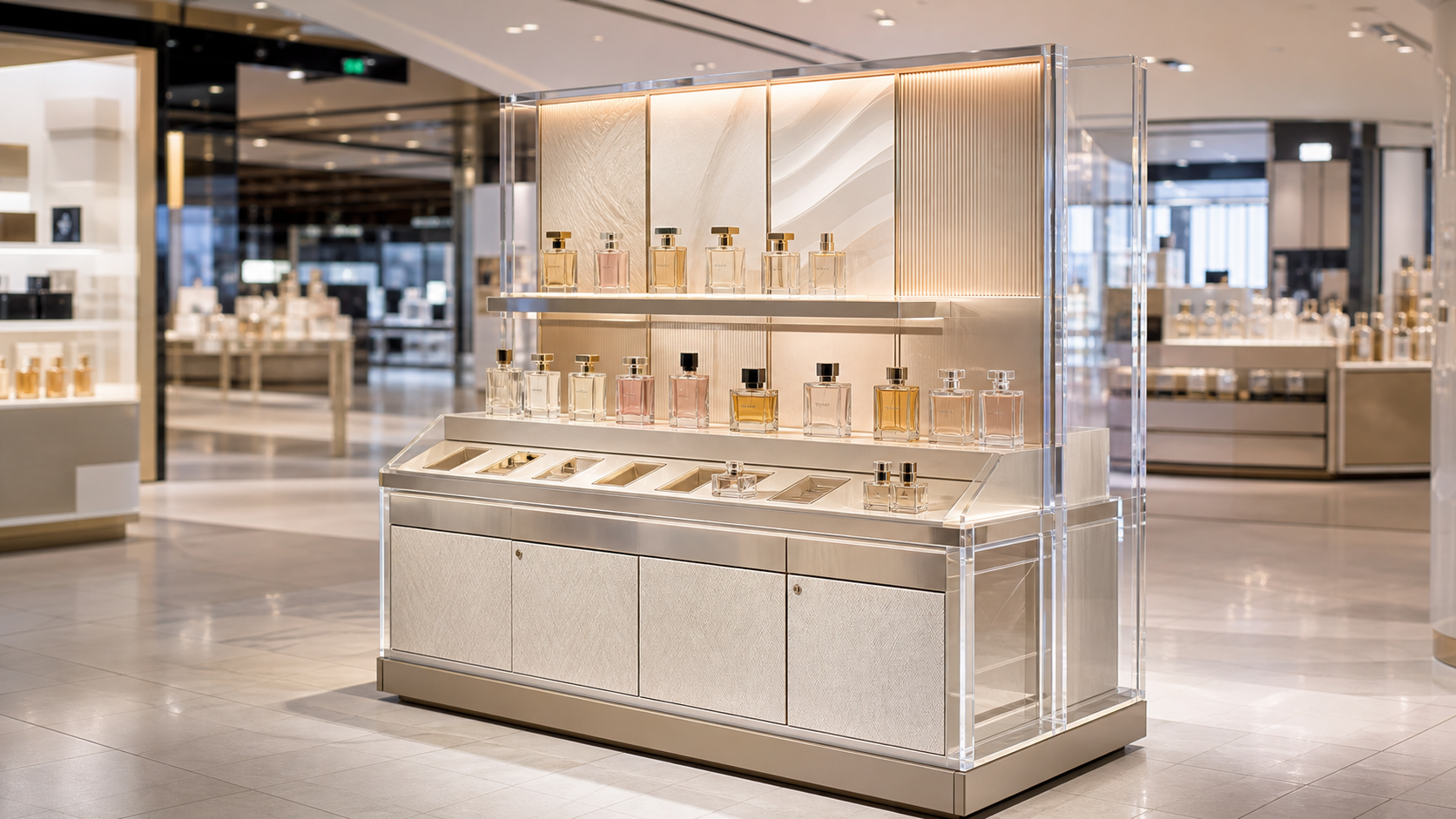
Duty free POS displays are point-of-sale fixtures planned for travel-retail environments where space, operating procedures, valuable products, and installation requirements must work together. They may take the form of a counter unit, wall bay, gondola element, promotional tower, or a compact branded zone within a larger retail system.
The main difference is coordination. A standard counter may serve one store format, one graphics language, and a predictable replenishment route. An airport retail fixture may need to fit a constrained footprint, remain clear from several approach angles, accommodate multilingual artwork, control access to saleable stock, and arrive in a form that installers can identify and assemble efficiently.
The product page for a duty-free perfume display solution shows available commercial directions. This planning guide addresses the upstream decisions that a brand, travel-retail team, and manufacturer must settle before a reliable concept and quotation can be produced.
| Planning factor | Standard beauty counter | Duty-free POS display |
|---|---|---|
| Operating pattern | Set by an individual store | Often planned for extended operating periods |
| Customer flow | Familiar local store path | Multiple approach directions and fast-moving traffic |
| Security | Open, locked, or staff-controlled by store policy | High-value stock and staff access usually require explicit zoning |
| Replenishment | Local stockroom and routine store process | Route, frequency, and secure storage must be defined in the brief |
| Lighting | Matches the store concept | Must coordinate power, heat management, access, and planned operating hours |
| Graphics | One language or campaign set | May require language, price, and campaign changes by market |
| Installation | Managed under local store conditions | Packaging, labels, site access, tools, and installer instructions need early planning |
| Maintenance | Local staff or contractor | Service parts and access should be consistent across rollout locations |
Start with the Airport, Retailer, and SKU Brief
A duty-free display brief should describe the site constraints and the merchandise before it describes the visual style. The manufacturer needs a dimensioned space, the retailer or operator’s current fixture requirements, the passenger approach, and a complete bottle list.
Record the maximum width, depth, and height; floor or counter fixing points; neighboring fixtures; cable entry; sightline restrictions; and the direction from which customers first see the display. Do not assume that a concept approved for one location fits another. Dimensions, service access, power, graphics, and installation conditions should be confirmed for every destination or store group.
The SKU schedule should identify bottle dimensions, weight, base outline, cap shape, capacity variant, tester status, saleable-stock quantity, and planned replenishment frequency. A custom perfume display stand is most reliable when the layout is built from bottle drawings or physical samples rather than a single generic shelf size.
Separate the assortment into three roles:
- Hero products need strong sightlines and deliberate lighting.
- Testers need stable positions, comfortable hand clearance, and a defined return location.
- Saleable inventory needs clear identification, secure access, and a replenishment route that does not disturb testers or wiring.
Design Security Without Blocking Product Visibility
Security should control access to selected stock while preserving the bottle view and a practical staff-service sequence. The correct solution may combine open testers, restrained display units, and locked saleable stock rather than enclosing every item.
Mechanical cam locks provide simple access without power. RFID access can reduce key handling, while digital-password locks may suit projects with a controlled code process. For electronic options, confirm the reader or keypad, controller, credential responsibility, power-failure behavior, and emergency mechanical opening. Audit records are available only when the selected hardware and software explicitly support them.
Bottle stability is another layer of protection. A CNC-machined recess of approximately 3–5 mm can follow a perfume bottle’s base profile to help resist sliding and vibration. The recess should not trap cleaning residue or make the bottle difficult to lift. Review lockable cosmetic display cases when the brief requires enclosed stock, access hardware, or a dedicated security zone.
Rear replenishment can keep staff activity away from the main presentation face, but only where the site layout provides safe access. Front doors or drawers may be more practical in a constrained space. In either case, test the opening path, lock position, staff reach, and interaction with neighboring fixtures before approval.
Plan Lighting for Long Retail Operating Periods
Lighting for a travel retail display should be specified as an electrical and maintenance system, not a decorative line on a rendering. Define the planned operating hours, target appearance, power source, driver position, cable path, heat-management method, and replacement access.
HileDisplay can engineer 12V or 24V low-voltage LED arrangements with hidden wiring. A CRI of 90 or above can support accurate product and packaging color, while a color-temperature range around 4000K–4500K is available; the final target must follow the brand and channel brief. Higher-output LED strips can use an aluminum heat-dissipation substrate.
The prototype should validate brightness, reflections on glass bottles, color consistency, surface temperature, cable strain, and driver access under the intended operating pattern. Every lighting target remains project-specific because components, enclosure geometry, ambient conditions, and operating schedules affect the result.
Design Around Perfume Bottle Geometry
Perfume POS displays should be engineered from the bottle base upward because glass packaging combines value, weight, reflective surfaces, and varied centers of gravity. Two bottles with similar capacity can require different recesses, shelf depths, spacing, and lighting angles.
Request dimensioned drawings or samples for the smallest, largest, tallest, and heaviest formats. Check cap removal, tester spraying, hand clearance, label visibility, and whether an adjacent bottle can be returned without contact. For inclined or tiered positions, confirm that the restraint acts on a stable part of the package and does not cover brand graphics.
Lighting should reveal the bottle without creating distracting glare. Test edge lighting, backlighting, or controlled shelf lighting with the actual liquid color and packaging finish. Reflective caps, clear glass, opaque cartons, and colored fragrances respond differently, so the physical sample is the decision point.
Use Modular Graphics for Multi-Market Rollouts
Modular graphics allow a core fixture to support different languages, launches, prices, or retailer requirements without replacing the entire structure. Useful options include replaceable inserts, magnetic logo elements, removable header panels, and separately packed campaign graphics.
Create a market matrix that maps each destination to its approved language, artwork revision, electrical component, plug, dimensions, and delivery label. Assign a revision code to every graphic and match it to the packing list. This reduces the risk of installing the correct fixture with the wrong market artwork.
Modularity does not mean every part should be removable. Frequently updated communication belongs in accessible modules, while structural and electrical components should remain secure. The brand can also review HileDisplay’s mall, pop-up and duty-free retail displays when aligning fixture formats with channel use cases.
Prototype, Package, and Deliver the Display
A 3D rendering is useful for reviewing proportions, graphics, sightlines, doors, and bottle placement. HileDisplay can provide an initial rendering within 24 hours after receiving complete, confirmed project inputs. A physical sample is still required to assess stability, access, finish, lighting, assembly, and packaging.
Sample delivery is typically 7–15 days, depending on approvals, materials, hardware, complexity, and shipping. Before production, freeze the approved drawings, bill of materials, graphics, electrical parts, security hardware, assembly method, and packaging configuration.
Packaging can combine protective film, EPE or foam corner protection, and double-wall high-strength corrugated cartons. Label packages by fixture, market, location, and assembly sequence where the rollout requires it. HileDisplay supports FOB, CIF, and DDP trade terms, but destination scope, customs responsibility, delivery point, and unloading or installation work should be confirmed in the quotation.
Duty-Free POS Display RFQ Checklist
Send one coordinated RFQ package rather than separate visual, purchasing, and installation requests:
- Airport or retail location, operator, and current fixture requirements
- Dimensioned site plan, photos, approach directions, and adjacent fixtures
- Complete bottle list with dimensions, weights, base profiles, and samples if available
- Tester, display-only, and saleable-stock quantities
- Security zones, lock preference, authorized users, and backup-access method
- Lighting appearance, voltage, operating schedule, power entry, and target market
- Replenishment route, staff access, cleaning, and maintenance responsibilities
- Artwork files, languages, revision codes, and replaceable graphic elements
- Prototype quantity, rollout quantities, market matrix, and in-store dates
- Packaging, assembly, labeling, trade term, destination, and delivery constraints
Frequently Asked Questions
What information should a duty-free POS display brief include?
Include the site dimensions, customer approach, SKU list, bottle weights and base profiles, tester and stock plan, security method, lighting and power, replenishment route, graphics languages, quantities, destinations, installation constraints, and required in-store dates.
How can a perfume display secure stock without hiding the products?
Use open, stable tester positions and secure saleable inventory in a locked drawer, rear compartment, or enclosed zone. Bottle-shaped recesses can improve tester stability, while clear materials and deliberate lighting preserve the product view.
Should a travel retail display use RFID or a cam lock?
Use a cam lock for straightforward, power-free access and RFID where credential management justifies the added hardware and maintenance. Confirm the controller, power-failure response, permissions, records, and mechanical override before choosing an electronic system.
How should duty-free fixtures be prepared for several markets?
Use a destination matrix covering dimensions, language, artwork revision, electrical components, packing labels, and delivery details. Keep frequently changed graphics modular and freeze a market-specific bill of materials before production.
Request a Duty-Free POS Concept
Send your airport or retail location, counter dimensions, bottle list, tester and stock plan, security requirements, lighting and power brief, destination matrix, quantities, and rollout dates.
Contact HileDisplay to request a duty-free POS display concept built around bottle visibility, controlled access, maintenance, installation, and international delivery.