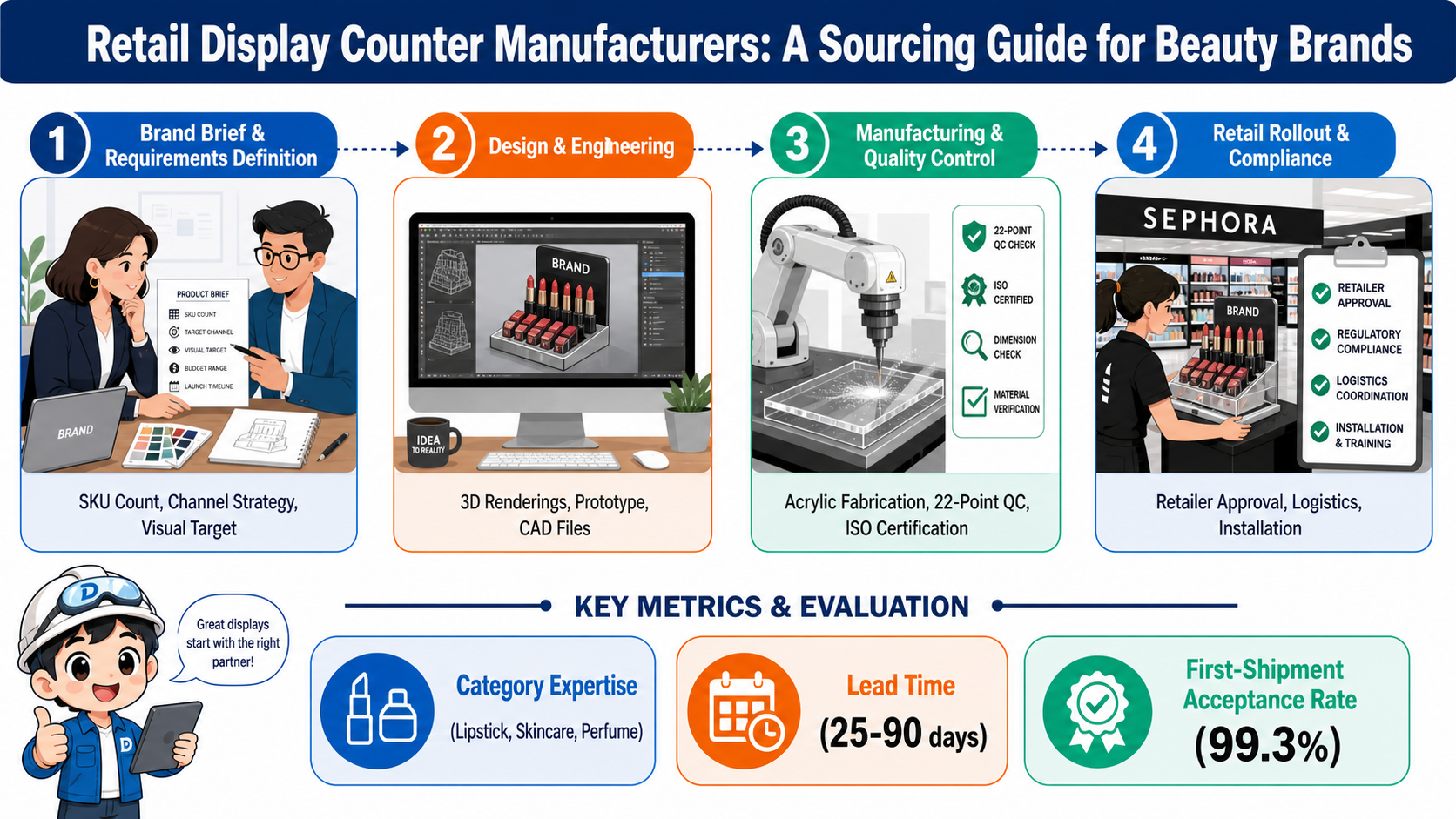
Choosing the right retail display counter manufacturers is a strategic sourcing decision for beauty brands, not a simple fixture purchase. A lipstick tray, skincare tester bar, fragrance counter, or custom acrylic cosmetic display must protect fragile products, express brand identity, support store operations, and satisfy retailer compliance requirements before rollout. This guide will answer critical questions like how to evaluate a manufacturer, what specifications matter for retail countertop display projects, and when to choose OEM, ODM, or private label display production to ensure you make an informed decision.
For beauty brands moving from DTC into physical retail, the display counter becomes the sales interface between packaging, shopper behavior, and store staff workflow. A well-engineered acrylic countertop display case supplier can help translate a creative brief into CAD drawings, prototypes, production tooling, quality control, and delivery documentation. This sourcing guide explains the technical, commercial, and compliance criteria procurement teams should use before selecting a partner for lipstick, perfume, skincare, K-beauty, nail polish, and multi-category cosmetic displays.
Why Beauty Brands Need Specialized Retail Display Counter Manufacturers
Beauty retail is more demanding than many general merchandising environments because products are small, high-touch, visually driven, and often sold through strict retailer programs. A general fixture vendor may understand shelves, but a specialized cosmetic display manufacturer understands shade navigation, tester hygiene, SKU density, fragrance shrinkage, LED color rendering, acrylic polishing, and store reset timing. For example, lipstick displays must fit common tube diameters from 12mm to 18mm, foundation displays should support shade-card logic, and skincare counters often need tester pump positions with spill trays. These requirements directly affect conversion, loss prevention, and daily staff workload.
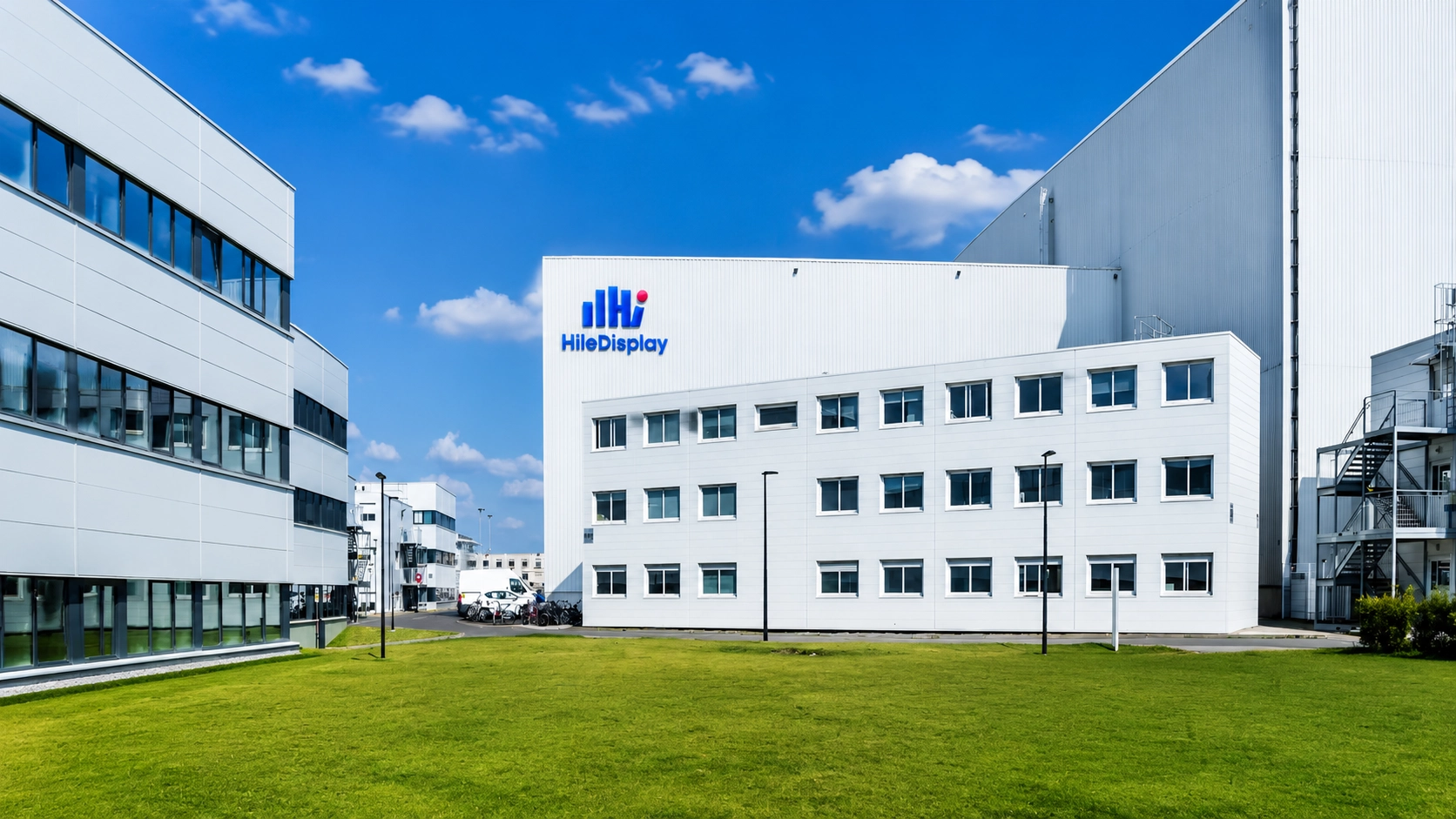
The strongest retail display counter manufacturers also engineer for channel requirements. A display entering Sephora, Ulta, department stores, airport duty free, pharmacy chains, or pop-up events may need different packaging, labeling, electrical certification, flame-retardant material choices, assembly instructions, and installation coordination. Hiledisplay’s background reflects this specialization: founded by acrylic engineers in Shenzhen in 1996, the company has spent decades focusing on cosmetic retail displays, supported by a 10,000-square-meter factory, in-house design, fabrication, surface finishing, and quality control teams. That vertical focus matters because cosmetic displays are not just decorative; they are retail tools built for measurable operational outcomes.
Core Evaluation Criteria for Retail Countertop Display Projects
Before requesting quotations, procurement teams should define the performance criteria of the retail countertop display. The first criterion is product fit: the supplier should confirm bottle, tube, jar, compact, palette, brush, or mask dimensions before tooling. The second is shopper behavior: a lipstick display may need angled browsing, while an eyeshadow palette display may need a mirror, swatch strip, and 25-degree tilt. The third is retail durability: countertop fixtures are touched daily, cleaned frequently, and exposed to product residue, so thin consumer-grade acrylic is rarely sufficient for commercial use.
Material, process, and certification should also be reviewed. Acrylic displays may use PMMA GP, optical-grade PMMA, tempered glass, aluminum, brass trims, wood bases, steel reinforcement, LED drivers, or RFID locks depending on the use case. Hiledisplay’s manufacturing knowledge base includes laser cutting, CNC machining, UV printing, screen printing, engraving, heat bending, diamond polishing, assembly, and a 22-point quality control system. For international rollout, buyers should also check quality and environmental management frameworks such as ISO 9001 quality management and ISO 14001 environmental management, along with applicable electrical and material documents.
| Evaluation Area | What Buyers Should Verify | Why It Matters for Beauty Retail |
|---|---|---|
| Category Expertise | Experience with lipstick, perfume, skincare, foundation, K-beauty, nail polish, and testers | Category-specific engineering reduces poor fit, messy testers, shade confusion, and product damage |
| Design Capability | 3D renderings, CAD files, BOM, physical prototype, and revision workflow | Helps brands approve appearance, dimensions, and production feasibility before mass production |
| Acrylic Fabrication | CNC, laser cutting, heat bending, polishing, printing, and assembly in one facility | Improves tolerances, finish consistency, and intellectual property control |
| Quality Control | Documented inspection points, pre-shipment checks, and sample approval process | Prevents scratches, edge defects, poor bonding, unstable structures, and retailer rejection |
| Compliance Support | ISO, electrical certification, retailer packaging, labeling, and installation documentation | Reduces risk during supplier approval, customs, distribution center receiving, and store installation |
| Scalability | Prototype, pilot, 50-bay rollout, 500-bay rollout, or 10,000-piece production capacity | Allows brands to grow from trial stores to regional or global retail programs |
OEM, ODM, Private Label, and Custom Design: Which Sourcing Model Fits Your Brand?
The right sourcing model depends on how much design control, engineering support, budget flexibility, and speed your project requires. OEM is best when the brand or its design agency already has production-ready CAD drawings, specifications, and visual standards. In this model, the manufacturer focuses on tooling, material procurement, fabrication, quality control, retailer compliance review, freight coordination, and production execution. Hiledisplay’s OEM process includes feasibility review in approximately 3 to 5 days, custom mold creation in about 10 to 15 days, parallel production, and 22-point inspection before shipment.
ODM is better for brands with a clear retail vision but limited internal industrial design resources. Hiledisplay’s ODM workflow can begin with a brand brief and mood board, move through NDA signing and project kickoff within 2 to 3 days, then develop 3 to 5 rounds of high-realism 3D renderings and specifications. A physical prototype can be produced in 10 to 15 days before tooling, with CAD files and BOM prepared for scalable OEM production. Private label is the fastest and lowest-MOQ route when a brand can adapt an existing validated base design with Pantone color, laser-cut logo, screen printing, and spacing changes. Hiledisplay maintains more than 50 verified base designs across seven display forms, with MOQ from 25 pieces and typical lead time of 25 to 35 days.
| Sourcing Model | Best For | Typical Deliverables | Speed and Cost Profile |
|---|---|---|---|
| OEM Cosmetic Display Manufacturing | Brands with production-ready CAD drawings and technical specifications | Tooling, material sourcing, production, QC, compliance pre-check, freight coordination | Efficient for mature projects; tooling cost depends on structure complexity |
| ODM Cosmetic Display Engineering | Indie, DTC, or retail-entry brands needing design-to-production support | 3D renderings, prototype, CAD files, BOM, engineering IP transfer, production handoff | More development support; useful when design resources are limited |
| Private Label Display | Pop-ups, trade shows, early retail tests, and low-MOQ launches | Existing base design plus Pantone color, logo, graphics, and minor spacing changes | Fastest launch path; MOQ can start at 25 pieces |
| Custom Design and 3D Rendering | Brands needing concept validation before mass production | Brand brief analysis, 3D render iterations, prototype, production-ready documents | Hiledisplay can move from brief to review-ready prototype in about 6 weeks |
Technical Specifications That Define a High-Performing Acrylic Countertop Display Case
An acrylic countertop display case should be specified with more detail than width, depth, and logo position. Buyers should clarify acrylic grade, material thickness, edge finish, bonding method, load capacity, cleaning resistance, anti-tip stability, and optional coatings. For retail counters, common dimensions may range from 30 to 80 cm wide, 20 to 40 cm deep, and 15 to 50 cm high, with acrylic thickness often selected from 3mm, 4mm, or 5mm depending on product load and structure. Hiledisplay’s countertop solutions also consider base-to-height ratios, cable openings, magnetic price tag pockets, tablet bases, tester storage, and step display modules.
For premium beauty, surface finish is a conversion factor. Diamond-polished or flame-polished edges create a cleaner appearance at close interaction distances, while frosted, Pantone-colored, brass-trimmed, wood-base, or stone-pattern panels can support brand positioning. LED-integrated displays require additional specifications such as 12V DC power, color temperature, CRI, dimming, heat control, and certification. Industry references such as European Commission CE marking guidance and UL product safety resources are useful when evaluating electrical display programs for multiple markets. For acrylic material verification, third-party testing organizations such as SGS can support material safety and performance documentation.
Category-Specific Display Design: Lipstick, Skincare, Perfume, K-Beauty, and Nail Polish
The best retail display counter manufacturers do not use one generic tray for every beauty category. Lipstick requires tight tube fit, shade-family browsing, tester-and-stock pairing, and sometimes anti-sweep geometry. A countertop lipstick display may use 12, 24, or 36 holes, 14mm, 16mm, or 18mm inserts, and a 15-degree back angle so shoppers can view colors without bending. Hiledisplay’s lipstick solutions can pair testers with sealed back stock so beauty advisors can replenish quickly, while rotating lipstick towers can support 144 to 216 units in compact footprints.
Skincare counters need a different logic. Consumers often shop by routine step and skin concern, so vertical columns for cleanser, toner, serum, moisturizer, and SPF can be combined with horizontal concern zones such as anti-aging, brightening, hydration, or sensitive care. Hiledisplay’s luxury skincare displays can integrate 5500K cool white LED backlighting, CRI 95+ lighting, pump tester positions, drain trays, and ingredient storytelling panels for retinol, vitamin C, peptide, or niacinamide education. Perfume displays require even more security because fragrance is high value, glass-packed, and vulnerable to shrinkage. Lockable fragrance displays, cam-locks, RFID locks, tester valve protection, and edge-lit acrylic can reduce loss while increasing visibility from several meters away.
K-beauty and nail polish have their own engineering requirements. K-beauty often combines sheet masks, ampoules, cushions, serums, and ingredient narratives in one bay, so display systems should use magazine slots, mini-bottle wells, cube pockets, and pastel acrylic finishes rather than one universal hole pattern. Nail polish displays must account for high SKU counts, glass weight, color-family browsing, and bottle stability. Hiledisplay’s nail polish solutions include rotating towers, wall systems, and floor racks with 5-degree rear-tilted shelves, deep bottle positions, and modular liners for 28mm, 30mm, or 32mm bottles.
Compliance, Certifications, and Retailer Approval Requirements
Retailer compliance can determine whether a beautiful display reaches stores on time or is delayed at supplier approval, distribution center receiving, or installation. Beauty brands should ask retail display counter manufacturers for certification records, packaging documents, electrical approvals, and retailer-specific compliance support early in the project. Hiledisplay states that it maintains ISO 9001, ISO 14001, CE, UL, PSE, RCM, FSC, SGS, and related documents on an annual renewal cycle, which helps reduce the risk of expired certification during long rollout programs.
Different channels impose different obligations. Sephora-style programs may review bay dimensions, LED CRI, PMMA material grade, transport packaging, and installation standards. Ulta programs may require GS1-128 shipping labels, pallet configuration, fire-retardant PMMA, and installation team documentation. Pharmacy and mass retail channels such as CVS, Walgreens, Target, Walmart, Boots, and dm often emphasize cost efficiency, flat-pack assembly, anti-theft hooks, quick store deployment, and large-scale delivery coordination. Sustainable documentation may also matter for global brands; resources such as the Forest Stewardship Council and life cycle assessment documentation can support responsible sourcing claims when wood, paperboard, or sustainability reporting is involved.
Manufacturing Capability: From Acrylic Fabrication to 10,000-Piece Rollouts
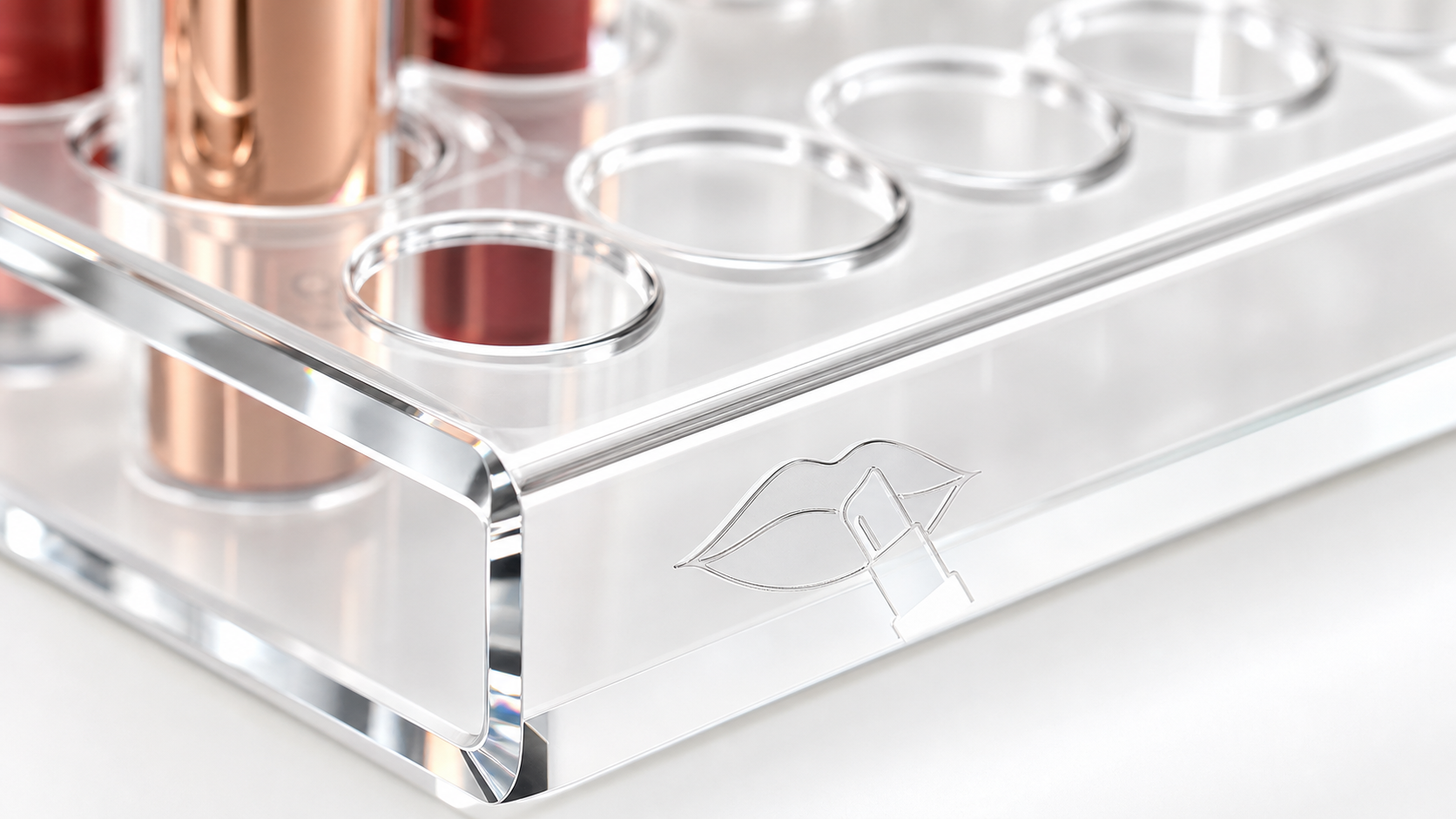
A manufacturer’s factory capability directly affects lead time, repeatability, and cost control. When laser cutting, CNC machining, heat bending, UV printing, screen printing, engraving, polishing, and assembly are outsourced to multiple vendors, communication gaps and tolerance inconsistencies become more likely. Hiledisplay’s integrated acrylic fabrication chain keeps key processes inside one 10,000-square-meter Shenzhen facility, including CNC, laser cutting, LED production, surface finishing, assembly, and quality inspection. The company states that its CO2 laser can process acrylic up to 25mm, laser cutting tolerance can reach ±0.1mm, and CNC capability includes 3-axis and 5-axis complex contour machining.
Scale matters when retail programs move beyond a prototype. A small cosmetic brand may need 10 test counters, then 50 first-wave displays, and later 500 or more bays based on sell-through data. Mass retail seasonal programs may require thousands of endcaps within strict reset windows. Hiledisplay’s knowledge base describes parallel production lines, in-house mold capability, a 22-point quality control checklist, 30 years of cosmetic display manufacturing experience, more than 200 cosmetic brand projects, and delivery coverage across more than 50 countries for manufacturing programs. For brands sourcing globally, these capabilities should be discussed alongside production slots, packaging cube optimization, phased freight, spare parts, and replacement procedures.
Lead Times, Prototyping, MOQ, and Cost Drivers
Lead time depends on whether the project is a standard tray, private label adaptation, custom countertop display, LED display, lockable case, airport duty-free cabinet, or multi-country retail rollout. Hiledisplay’s knowledge base provides practical benchmarks: standard lipstick trays can move faster, private label projects typically run 25 to 35 days, many custom countertop cosmetic displays require 30 to 45 days, LED skincare or fragrance displays may require 45 to 65 days, and airport duty-free perfume cabinets can take 70 to 90 days because of airport security review windows. A physical prototype can often be delivered in 10 to 15 days after rendering approval, while a full concept-to-prototype cycle can be completed in about 6 weeks.
Cost is shaped by material thickness, acrylic grade, mold complexity, LED integration, locking systems, surface finishes, packaging, retailer compliance, freight method, and order volume. A cam-lock may add a smaller cost than RFID, but RFID can provide audit trails required in duty-free or luxury environments. Flat-pack floor and endcap displays can reduce DDP cost compared with fully assembled shipping because components nest more efficiently. For early-stage brands, private label display programs with MOQ from 25 pieces can reduce tooling risk. For established brands, custom tooling can be amortized across larger rollouts, especially when the structure supports SKU updates without replacing the entire display.
Questions to Ask Before You Request a Quote
A professional RFQ should help the manufacturer calculate risk, not just price. Start with product dimensions, SKU count, product weight, tester requirements, retail channel, target launch date, artwork files, Pantone colors, logo method, electrical requirements, security requirements, cleaning expectations, packaging instructions, and delivery destination. If the display will enter a retailer program, include known compliance manuals, packaging standards, pallet instructions, installation restrictions, or vendor portal documentation. This information helps the supplier choose the right structure, material, assembly method, and production schedule.
Procurement teams should also ask about intellectual property handling, prototype ownership, tooling ownership, and documentation handoff. Hiledisplay’s ODM model states that engineering IP can be transferred to the brand, molds are assigned to the brand account, and molds are not shared with other brands. Buyers should also ask whether the factory can provide CAD files, BOM, rendering records, prototype photos, inspection reports, and freight coordination. If your brand is still defining requirements, use the company background and project capabilities to assess whether the supplier has enough category experience before sharing a detailed brief.
How Hiledisplay Supports Beauty Display Sourcing
Hiledisplay is positioned as a custom acrylic cosmetic display partner for beauty retail terminals, with capabilities covering lipstick, perfume, skincare, color cosmetics, K-beauty, nail polish, makeup brushes, seasonal sun care, pharmacy skincare, department store counters, and pop-up activations. Founded by acrylic engineers in 1996, the company combines design, manufacturing, surface treatment, quality control, prototyping, and global delivery coordination. Its mission emphasizes structural precision, brand expression, and shopper-centered ergonomics, which aligns with the real priorities of retail merchandising teams: visibility, product fit, durability, hygiene, loss prevention, and faster consumer decision-making.
For brands without production CAD, Hiledisplay can support concept development, 3D rendering, virtual sampling, physical prototyping, and engineering documents. For brands with existing design resources, the OEM route supports tooling, material procurement, production, QC, retailer compliance pre-check, and freight coordination. For quick launches, private label displays use validated base structures with brand-specific colors, logos, graphics, and spacing changes. The company’s project entry point allows brands to submit requirements through a “Start your project” form, with contact fields for email, phone or WhatsApp, company name, and message details, and the site typically indicates replies within one day.
Frequently Asked Questions
How long does it take to develop a custom acrylic countertop display from concept to prototype?
Based on the provided project workflow, Hiledisplay’s internal industrial design team can complete a concept-to-review-ready physical prototype in about 6 weeks. The process can include brand brief intake, 3 to 5 rounds of high-realism 3D rendering, dimensional specification documents, and a physical prototype within 10 to 15 days before tooling. After prototype optimization, CAD files and BOM can be prepared for OEM production handoff.
What is the difference between OEM, ODM, and private label cosmetic display manufacturing?
OEM is suitable when the brand already has production-ready CAD drawings and specifications, while Hiledisplay handles manufacturing, tooling, QC, compliance pre-check, freight, and delivery coordination. ODM is suitable when the brand has a clear retail vision but needs engineering design support from concept through prototype and production documents. Private label is the fastest, lower-MOQ option, using existing validated base designs with brand colors, logo, graphics, and spacing adjustments.
How can a supplier help reduce shrinkage in high-value perfume and luxury skincare displays?
Hiledisplay’s knowledge base describes lockable display options for high-value fragrance and luxury skincare, including cam-lock, RFID lock, and digital code configurations. For perfume, the company notes that unprotected shrinkage may reach 8% to 12%, while engineered lockable displays can reduce loss to below 1% in suitable scenarios. RFID options can also record opening events with timestamps and credential IDs for duty-free and luxury retail environments.
What quality control and certification support should buyers expect for international beauty retail rollouts?
Hiledisplay states that it uses a 22-point quality control checklist covering production processes and pre-shipment finished goods checks, with an indicated first-shipment acceptance pass rate of 99.3%. The company also maintains ISO 9001, ISO 14001, CE, UL, PSE, RCM, FSC, SGS, and related certifications on an annual renewal cycle. For retailer programs, it can provide compliance document packages to support supplier approval and channel-specific requirements.
Conclusion
Selecting retail display counter manufacturers should be treated as a cross-functional sourcing decision involving merchandising, procurement, engineering, quality, logistics, and retail operations. The right partner will understand beauty-specific product geometry, shopper behavior, tester hygiene, acrylic fabrication, LED safety, loss prevention, retailer compliance, and phased rollout planning. Whether your project is a retail countertop display for lipstick, an acrylic countertop display case for luxury skincare, a K-beauty bay, a fragrance counter, or a mass retail seasonal endcap, the sourcing process should begin with clear specifications and evidence-based supplier evaluation.
If your brand is preparing a pilot, retailer launch, pop-up event, or multi-country rollout, Hiledisplay can help turn a display concept into a manufacturable retail fixture through OEM, ODM, private label, custom design, prototyping, acrylic fabrication, and quality-controlled production. Visit the product solutions page to explore display categories, or start from the Hiledisplay homepage to submit your project requirements and discuss the right sourcing path for your next beauty retail display program.